All You Want to Know About SUGAR & Sugar Substitutes!

Oh I know you will hate me after this article! But I think I prefer you hate me alive and healthy than dead or sick… so let me start by saying: I don’t mind you feeling angry or pissed or downright slam the monitor into pieces but I must tell you what now many scientific articles and books tell you but not yet TV or doctors is this: TRASH all you sugar and sugar substitutes (and that includes fruit juices)!

I find it amazing how few publicly accessible literature or viewing sources advise you but I suppose the sugar farmers and the pharmaceuticals who must pump you with medicines after you get ill from sugars or sugar substitutes will not want to let you know that if you stop eating sugar or sugar substitutes, you will actually be perhaps healthy for the rest of your lives–preventing hypertension, diabetes, migraines, headaches, hypoglycemia, fibromyalgia of some forms, and several other neuronal illnesses, perhaps even dementia and Alzheimer’s. This will make them much less money and so they will do everything to stop its promotion.

So let me promote a “no sugar or sugar substitutes” campaign right here.

The problem I am facing is that unfortunately sugar substitutes are in everything: chewing gum, toothpaste, medicines, and just about everything you put into your mouth. Sugar is often added to food to keep bacteria away–it has an amazing dehydrating capacity that sucks the living daylight out of cells (including yours) and so it kills those cells (may I remind you here that your body is made of cells? And many of them are bacteria?).

Artificial sweeteners have no functions. They were brought on the market because people like sweet things but if sugar is bad for them, let them have the taste of sweet without it actually being sugar. Hence you get sweet taste but a taste that your body has no idea what to do with and no, it may not just pass through your system. Your body will try to digest everything you put into your mouth and so by the time it discovers that it cannot be used as sugar, it is too late.

So let’s talk a bit about the history of our society getting to the point that now we have 2-months old babies with diabetes II and newborn obese babies. Obviously it is not the baby’s fault; she cannot yet eat or drink junk food unless she is given but the newborn is given all its food in the mother’s womb through her blood! So what is in her blood that creates obese children or children with diabetes II even if the mother herself does not have either (yet)?

A few decades back in the 20th Century, people were starting to get fat and started diabetes II suddenly in increasing numbers. Depending on where you read the numbers, just in the decade that hugs the turn of the century there was a 90% increase in diabetes II in the US according to Dr. Mercola. Another study shows the increase to be (in the year 2000) over 33% of the population of adults over the age of 20 and  50% in children obesity in the US.

Both studies blame fast food and sedentary lifestyles but is that true?! I know several people who are athletes, run Marathons, never go near fast food places and still are obese and/or have diabetes II.

We clearly are facing an epidemic. In the middle of the 20th Century they blamed fast foods because of the fat, so the food manufacturers reduced fat but since the taste was gone, they added sugar. By now we know the end result of that experiment with the US population: we all got fatter and diabetes II skyrocketed at an exponential rate even faster than before. So it is not the fat or the fast food or the sedentary lifestyle if Marathon runners can be obese who never eat fast food and eat the same low-fat foods that are advertised. So what went wrong?

This question is very valid. If you think that taking fat out of food does not mean putting sugar into it, look again. The best way to look is by grabbing a brand of jug of milk in all its fat content varieties and compare. You will see that whole milk has 4% fat and say 10 grams of sugar (each brand is different). If you look at the same brand of milk and now compare the whole with the 2% fat, now the sugar content is 11 grams and the protein is also likely up. The 1% fat will have 12 grams of sugar and the skim milk 13 grams. So as you go down with fat, you go up with sugar. It would also be nice if you could have a visual of the percent of fat removed versus the amount of sugar added. Do this: next time you go to the supermarket, look for the whole milk, organic, that comes in a clear glass. Buy that and open it. On the very top there will be a layer about 1/4 inch think of cream. That is the fat! If you take that off, you basically get low-fat (not quite skim but nearly) without any added sugar. If you really believe that you need to eat low-fat, do that.

But note also the opening of that jar of milk is about 2 inches max. The thickness of the fat is about 1/4 inch. If you put that into a teaspoon, you fill it almost to the top, not quite. Now 1 teaspoon of sugar is 4 grams. So basically having near skim milk, added an entire teaspoon of sugar to the milk. Is that really what you wanted?

Given that the population in the US (and in other countries where food only changed by sugar and sugar substitutes) obesity and diabetes II increases at an alarming rate, the guilty factor is clearly not fat or junk food but sugar. In fact in countries where they do not even eat junk food or fat but eat a ton of sugar (India for example) suffers greatly from diabetes II and they do eat a ton of sugar.

Why do sugar and sugar substitutes constitute such danger to our lives? This is a bit scientifically complex because the secret is in the metabolic pathway sugar and sugar substitutes take that are different from fat and other foods we eat. I will simplify greatly in the next few paragraphs so you can relate to it. So let’s start about the metabolic pathways in simple terms.

First lets eat a slice of steak. As we eat steak, it has the following nutritional value as per Wikipedia:

  1. Nutrition Facts
    Beef, ground, 85% lean meat / 15% fat, broiled

    Amount Per 1 serving (3 oz) (85 g)

    Calories 213
  2. % Daily Value*
    Total Fat 13 g 20%
    Saturated fat 5 g 25%
    Polyunsaturated fat 0.4 g
    Monounsaturated fat 6 g
    Trans fat 0.9 g
    Cholesterol 77 mg 25%
    Sodium 61 mg 2%
    Potassium 270 mg 7%
    Total Carbohydrate 0 g 0%
    Dietary fiber 0 g 0%
    Sugar 0 g
    Protein 22 g 44%
    Vitamin A 0% Vitamin C 0%
    Calcium 1% Iron 12%
    Vitamin D 1% Vitamin B-6 15%
    Vitamin B-12 36% Magnesium 4%


So as you can see, it has no sugar. But does eating a slice of steak activate insulin? Yes. It does. The actual job of insulin in not just to put sugar away! Insulin’s job is to convert the food you eat into sugar and then to fat and deposit it for later use. So if you did not eat sugar, your body is still getting sugar! If you eat sugar instead of a steak–just as an example–the sugar need not be converted to sugar (it already is sugar) so you just removed half of the job of insulin. This makes the insulin released (twice as much as needed) float around in search of work to do. Finding none, it does not exit for quite some time from your blood. Floating idle insulin in the blood causes insulin resistance, which is type II diabetes.

So let’s talk a bit more about sugar since there are many kinds of sugars: glucose (also called blood sugar), sucrose, and fructose. If you have diabetes II, the sugar pills you should have with you are glucose. I do not have diabetes but I carry that sugar with me for others. Try it once and see what it tastes like: you put a pill–quite large, I would say a good inch in diameter–on your tongue and before you can blink it is gone and is in your blood. It is barely sweet at all–almost not sweet. This means that the sugar our body needs is actually not that sweet!

But we have a problem. If you have a cup of coffee for example and you put a glucose tablet into it, it will not become much sweeter than it was before. The sugar industry realized this real quick and went after sugars that are sweeter. The best of those sugars are fruit or vegetable sugars, such as sugar cane, corn, beet, dates, etc., in a concentrated form. These fruits contain very high levels of sugar but the sugar is hidden inside of fiber (eat a piece of sugar cane and see!) so in order to get access to the sugar, they had to squeeze it, cook it, etc. There is a whole process of getting sugar out of these edibles but not that much–try to squeeze a raspberry for its sugar content–and so they have to concentrate it. They also add additional sugars in the process: glucose, sucrose (also natural sugar), and of course the fructose they just squeezed and cooked and dried the daylight out of from the sugar cane. They mix these three and sell them as table sugar. What exactly are you getting now? Is this still sugar your body can digest?

No actually, the body cannot digest anymore much of that sugars because it can only digest the glucose and sucrose. It does not digest fructose! But fructose is in every fruit, including the raspberry you just ate so how come your body can digest it in the raspberry but not in the crystallized or liquid forms? It has a metabolic problem. If you eat a raspberry, it contains insoluble fiber which takes the sugar all through to your bowel or large intestines, where the sugar is actually used by the good gut bacteria rather than your body! If there is no fiber, the fructose component will be absorbed earlier (this is similar in action to taking a medication that is coated to dissolve in the intestines instead of the stomach for example) and will hit the liver in full for detoxification. The problem is that it is toxin in whole so the detoxification process will make it stay in the liver that does the best job it can to change its molecular structure into a not-so-toxic element, which is ethanol alcohol. Yes, this is the same stuff we in the US put into our car to improve gasoline efficiency… so next time you drink orange juice, know that you just fed yourself (and your kinds!) alcohol and in the process you started what is called “non alcoholic liver disease” which is an enlarged liver as a result of keeping all that alcohol inside.

But we have another problem as well! Insulin releases the moment it tastes sweet or food so insulin released and is floating not finding sugar because it is alcohol now in the liver so in addition to lingering and causing diabetes II as noted earlier, it also communicates with another hormone called Leptin that is supposed to serve sugar to the brain. Leptin tells the brain “there is no sugar so we are in obvious famine so stop all activities and reduce metabolism,” which then initiates your hunger again and sugar craving. More such no-sugar sugar reconfirms to the brain that you are starving and slows metabolism down even more and makes you into a couch potato as a result of it telling you that you have no energy. It is not that you are lazy but your brain will not let you exercise! There is a communication between brain and body!

So here you have it from sugar! Now let’s see about sugar substitutes! I think you may be seeing some connection here already but just in case, let me explain. Eating sugar substitutes is still food and still sweet. Insulin releases just as when eating real food with real sugar! So for those of you counting GI (glycollic index) thinking you are safe, listen up! It is not the GI that matters but how much of the insulin released is actually finding work to do! When eating/drinking sugar substitutes, insulin has absolutely nothing to do so 100% of it is floating in the blood as before, causing diabetes II. Plus, it signals Leptin that there is no sugar so Leptin will tell the brain the same as for sugar: we are in starvation mode, reduce metabolism and reduce all nonessential activities. The outcome: diabetes II and obesity. We have not changed a thing by switching from sugar to sugar substitutes.

Additionally, we are causing serious damage. Insulin is a hormone but as you can see, it does not work alone. It works with Leptin in the case of the brain and works with many other hormones in the rest of the body. Every single cell in our body needs to gets its energy from the sugar that Insulin converted to fat which then converts back to sugar for the use of the cell. Giving sugar in any other way interrupts the hormones’ natural cycle. The problem is that everything we do in life is hormone driven. If you think you can do as much as blink without the use of at least one hormone, think again. The brain is one giant hormonal glad, like it or not.

As a result of the mislead insulin, type II diabetes, and obesity, our muscles (the mitochondria in the muscles) do not get proper oxygen for their breathing–this includes heart muscles too! Because the cells cannot work and breathe, they also cannot hydrate properly since sugar is a vasoconstricting “drug” similarly to caffeine, also dehydrating and thereby not letting water enter the cells. The overall effect on our health is: increased cholesterol of the bad kind (LDL), increased triglyceride (bad cholesterol relative to the sticky stuff inside of the bad cholesterol), thus increased blood pressure and hypertension. Heart problems are then given. Since it also blocks proper hydration that is necessary to prevent migraines as per my book, you will increase your migraines and headaches in general.

In terms of fibromyalgia, the votes of my survey are not yet all in but so far the findings hint to the fact that most FM sufferers eat a lot of sugar and drink way too little water. Thus sugar also blocks hydration of the nerve cells, which hurt fibromyalgia patients tremendously. I am not sure how increased obesity or diabetes II connect to fibromyalgia yet but I do know from several sufferers I asked that they all had both obesity and diabetes II. Thus both sugar and sugar substitutes interfere with the body enough to exacerbate (if not cause) fibromyalgia.

Comments are welcome, as usual,

Angela

Posted in Fibromyalgia, Interesting reading, Migraine-Blog, Must Read, This & That, Thoughts | Tagged , , , , , , , , , , , , , , , , , , , , , , , , , , , , | 2 Comments

The Killer Artificial Sweeteners and Sugars

I have been saying this for some time on my blogs, in my book, and also on my many Facebook groups and pages: artificial sweeteners cause diabetes II and obesity.

Most people continue to drink and eat food with artificial sweeteners in spite of the warning. Hopefully soon artificial sweeteners will be pulled from shelves and the debate will be over. It is a poison that creates illnesses. Not sure how many of you actually believed what I wrote in past blogs and in my book but I usually write based on scientific information that is not yet publicly available. Now finally it is available to the public in a limited way.

So if you did not believe me until now, perhaps you will once you read the latest release from Nature, a peer-reviewed scientific journal of the highest caliber among scientists. Unfortunately the subscription cost to the journal is prohibitive ($199 per year) and even to purchase this one article as a full text pdf costs $32. Given that few have such access and I am not allowed to post the article, I can only post here the news release that is public–click on this link to read it.

If you crave sugar and keep on eating/drinking artificial sugar, your craving will increase! In quick summary, here is what happens when you eat artificial sweeteners:

  1. Artificial sweeteners arrive into the body and insulin releases
  2. Insulin would convert it into sugar and deposit it as fat for future use but we have a problem. There is no sugar. There is nothing to convert into fat reserves except whatever came in with the fake stuff, say a muffin.
  3. The brain has a hormone called Leptin that orders sugar from Insulin but…
  4. There is no sugar for the use of the brain so Leptin initiates a “STOP ALL ACTION WE ARE IN STARVATION MODE” command
  5. The brain doesn’t have enough sugar so it does three things:
    1. Reduces your metabolism to reduce your food burning speed
    2. Reduces your ability to work and exert energy to save it for better times when there is food available
    3. send out sugar craving signals so you eat more of the fake stuff
  6. In the process of all these your metabolism slows down because your body thinks you are starving
  7. You keep on craving more and more food and so you gain weight and from all the insulin you released you are in trouble
  8. Insulin floating in the blood constantly without any purpose is called “cry wolf”
  9. Cry wolf gets to be ignored
  10. Ignored Insulin is called insulin resistance, or type II diabetes

Please read the news release and please stop drinking and eating artificial sweeteners! Do yourself a favor and trash it all!

Now all you need to know about “real” sugar (this includes Stevia and other such “real” sugars):

Some people I talked to complained, as noted before, but I crave sugar or I only eat Stevia. You already know what happens when you eat artificial sugar but what happens when you eat table sugar or honey or any kind of sugar you can buy in the stores, including Stevia? Is that any different from artificial sugars? Yes it is but how?! And is it any better? No. And here I give you all the answers you have ever wanted to know about sugar.

First I must explain that there are two major types of sugars in what we think of as sugar: glucose (the sugar our body knows what to do with) and fructose (not sugar for our body unless it comes with insoluble fiber, this includes sugars like honey or stevia or corn syrup and many more!). So watch out, this will be a bumpy ride for sugar lovers of any kind!

I can explain why you crave sugar even if you never ever touched artificial sweeteners in your life.

Sugar is an element that our body uses; each cell in our body (the mitochondria in particular uses it for breathing in oxygen) uses sugar as energy. But sugar is available to our bodies without eating sugar! Our body was made to convert non-sweetened food into sugar. That is the job of the many hormones, such as insulin, to convert the food you eat into sugar and deposit that as fat for future use. Eating food without sugar–yes, eating carbs that convert to glucose–is an important element of healthy eating and sugar availability without eating sugar! So if you don’t believe in eating carbs, watch out! You will be in metabolic trouble in no time!

When you eat unsweetened food (just in simple terms); the healthy way:

  1. Food gets digested and insulin releases
  2. Insulin converts whatever it can from the food into sugar and deposits it as fat for future use
  3. The brain has a hormone called Leptin that orders the delivery of sugar from this fat reserve
  4. Sugar is created from the fat reserve for the use of the brain
  5. The brain receives sugar and is happy, you are full of energy, awake, ready for life
  6. In the process of all these you burn energy (called metabolism)

When you eat pure sugar without insoluble fiber (natural pure sugar from evaporated freshly squeezed orange juice by you at home, for example) instead of food without sugar or food with sugar in it (again, natural that you created or table sugar, just in simple terms again):

  1. Food gets digested and insulin releases
  2. Insulin converts the food into sugar and deposits it into fat
  3. Insulin finds sugar but it needs to break that up: glucose and fructose since added sugar is made of these (including the freshly squeezed and evaporated sugar from orange juice you just made as well as corn syrup, honey, etc., are all concentrated fructose)
  4. The part of the sugar that is glucose, the insulin places as fat reserve without any work so your weight suffers a chance of losing some pounds there–this is called foods with glycemic index or GI. But GI is OK for you.
  5. The part of the sugar that is fructose is not convertible to fat. It goes to the liver and is converted into ethanol–the stuff you put in your car. It is alcohol (yes, we are feeding our kids alcohol!)
  6. Leptin is released from the brain and instructs insulin to gather sugar for the use of energy for the brain but Insulin is sending mixed signals. On the one hand it sends the message that there is more sugar but on the other hand it finds none so it tells Leptin what it finds
  7. Leptin tells the brain that there is a shortage of food since there is not enough sugar
  8. The brain puts on a “STOP ALL ACTIONS WE ARE IN STARVATION MODE” command
  9. You get to crave more sugar as a result. A catch 22.

The fact that when you eat sugar only part of that is really sugar is insult to injury since your body is already confused by releasing a ton of insulin to convert your food to sugar, which it need not do. When you eat fruits, vegetables, etc., the fructose is with insoluble fiber, making it difficult for the body to take sugar out of the food and thus it takes a lot of time for it to be digested. The insoluble fiber releases its sugar in our intestines and gut and not in our stomach. It is particularly useful in the gut as insoluble fiber sugar is food for the good bacteria. So if you eat right, you need not eat probiotic at all! The bacteria are already in your gut and believe me, the one thing they know real well is how to multiply!

If you need to eat probiotic, you are not eating right! If you crave sugar, you are not eating right!

Eat right and stop craving things your body can make on its own. Eat only foods your body cannot create!

Comments are welcome, as usual.

Angela

Posted in Interesting reading, Migraine-Blog, Must Read, This & That, Thoughts | Tagged , , , , , , , , , , , , , , , , , , , , , , , , | Leave a comment

Salt; the Good, the Bad, and the Evil. Finally It Is the GOOD!

Salt has been on the “bad food” list for some time now in the US and also in other countries, particularly in the UK. It ended up as “bad” because some researcher showed some correlation (incorrectly) that salt and blood pressure are correlated in a negative way, meaning the more salt you eat, the higher your blood pressure will go. This turns out to be an untrue statement!

Yes I know, some people are still low salt advocates, like Dr. Sanjay Gupta on TV who constantly discusses how bad it is but then he also discussed how bad other things were only to change his mind later. Thus his expert opinion is as expert as the opinions of those who tell him what to say. Please do yourself a favor and search out the information for yourself if you want to learn the truth.

By now there are hundreds of articles, blogs, radio discussions, that discuss how many problems reduced salt causes! Finally the UK also started to wake up and the first article was found about opposing low salt. There are too many articles in the US to post links to… just google them. But let me explain why the researchers initially considered salt to be evil and why now research shows that they were wrong.

When you take a handful of mice or rats and inject them with salt, guess what: they will be sick. They are not used to eating salt. They are mice or rats and not people. Then you feed a ton of salt to people without matching it with the necessary elements such as water and potassium, magnesium, calcium and yes, you end up with a bunch of high blood pressure people. You also study people who eat junk food all the time and you conclude that junk food is bad for them but you are only focused on junk food and not what else they are eating or drinking!

Well let me tell you why salt doesn’t cause high blood pressure: it is not salt but what you eat with salt that matters. Your body is over 70% water they say. That is incorrect. Your body is over 70% brine containing water, salt, and other elements of electrolyte. Taste your sweat; taste your blood, taste any part of you by sucking on your finger. Everything on you and in you is salty. How can something that is a key element in your body and how your cells function be bad for you? And let me ask you this: how can your body function without something that makes so much of your body that you can taste it whatever body part you put into your mouth?

It may seem like a crazy thing to reduce salt from the diet of people when salt is the only ingredient in our bodies that can actually hold onto water we drink. Eat no salt, end up like a shriveled up prune completely dehydrated. This has caused a lot of illnesses, such as the epidemic of migraines all of a sudden, fibromyalgia, and even more heart problems.

I had a discussion the other day with one of my doctors and he said “duh, the heart muscles need salt for their sodium-potassium pump the same way as all other cells in the body” but this was a pulmonary specialist and his wise words add little to a medical institution of general medicine or heart or migraine specialties where they believe salt to be evil and reach for drugs instead. Clinical doctors look at the heart as an object of working muscles; they do not see how those muscles work using sodium-potassium pumps. They do know those pumps exist, but they are blind to the effect what happens when salt is not provided and those pumps don’t work.

What is salt’s connection to migraines? It is in my book I linked you to: it has a lot to do with the sodium-potassium pumps that allow water to enter for the sodium and allow fresh sodium and fresh potassium ions to enter. Potassium is diuretic so it takes toxic water out whereas sodium is water lover so it holds onto water. Chloride–the other half of salt, which is sodium chloride–remains outside the cells and provides for the electric potential to occur so the pumps can work. Without salt (sodium chloride) there is no electricity, the pumps don’t work, the cells cannot open their “mouths” if you will and no water can enter the cells.

Low salt does the same with the heart. It also means that our cells–including the fluid around blood cells–does not have enough water and so many end up with too low blood pressure simply by the lack of water volume in the blood–not good. Lack of healthy blood pressure means the blood doesn’t reach your brain and you end up with neurons that cannot function, neurons that have not enough electrical charge to manufacture or release neurotransmitters–many of which happen to be serotonin (not always of course)–hence then migraineurs are pumped up with serotonin medications to replace what lack of salt caused. Serotonin drugs are dangerous… go ahead… have some salt will you? Trash your serotonin medications slowly though because stopping it can land you in the hospital in no time.

Unlike stopping salt, stopping serotonin can be a nightmare and may take 6 months or years depending on how much you took and for how long. So start your salt, drink plenty of water and read my book Fighting the Migraine Epidemic to learn how to dose your salt, how to stop your foods from triggering a migraine, and how to have a healthy supple well hydrated body! It also improves your immune system since that too was dehydrated and hydration allows for those cells to also function. And guess what: it also improves your skin! That is an added and completely coincidental benefit that dehydrated cells are also dehydrated on your skin causing wrinkles! So hydrate by drinking water and eating salt as well as the rest of the ingredients in my book for complete healthy mind and cells!

Posted in Migraine-Blog, Must Read, This & That, Thoughts | Tagged , , , , , , , , , , | 2 Comments

Mind Over Body; Can You Do That?

Indeed, you can! This little video from TEDx by Lisa Rankin M.D. will show you how and why. Amazingly in part of her discussion right in the middle of this 19-minute presentation you will hear my Fighting the Migraine Epidemic book’s main theme: fight-or-flight and hyper sensory organs and how they interrupt the body’s natural mechanism and need more nutrients to recover.

Please watch this video all the way since the essence of the subject will only hit you toward the end. This is the second lecture I see from this medical doctor and all I can tell you is that I wish all doctors were like her! We would probably have no illnesses to cure.

Your thoughts are welcome!

Angela

Posted in Interesting reading, Must Read, This & That, Thoughts, Videos | Tagged , , , , , , , , , , , , , , , , | 3 Comments

Antidepressants for Anxiety? Why?

I spend a lot of time talking to migraine and fibromyalgia sufferers from all over the world, talking to them via email or Facebook or blog–some even phone. I consistently find–particularly in the Unites States–that anxiety related conditions are treated with antidepressants. This was very clear to me when I was a migraine sufferer and my migraine specialist wanted to place me on a serotonin preventive as she explained it is for depression but seems to work for many people with migraines.

This sent me to research the subject and of course it ended up in a book with a solution for migraine, finding the cause–which by the way shows that migraines have nothing to do with depression. I am very happy that I turned away from the serotonin preventive and in fact turned away from all migraine medications since they were all some form of triptans, which are serotonin.

As now my book on migraine is quite successful and many people are cured completely without any medications, I can stop and look why exactly are triptans offered for migraine when originally they are antidepressants. Is there a logical connection anywhere that I missed when I attended my doctoral classes on the brain? Have I missed the brain anatomy to such large degree that I cannot tell regions of anxiety and regions of depression apart? What exactly does the research community have available to make the statement that antidepressants will work on anxiety? And on those occasions when they actually do work–as sometimes they do–why do they work? And why don’t they work other times?

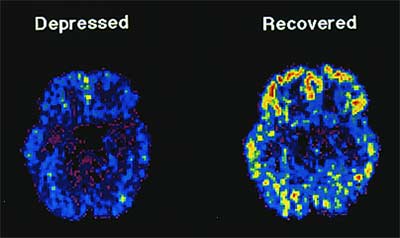
In this article I compare brain anatomy by pictures available on the Internet–I will be citing all publications and provide links so you can follow and read. Let me start by a couple of pictures of depression so you can see where in the brain the light areas are, which represent areas that were affected by depression when they did not light up.

PET scan depression

PET scan depression

This picture was taken from the website linked above. Here you can see on the PET-scan that the areas affected by depression are on the outskirts of the brain, following the serotonin pathways.

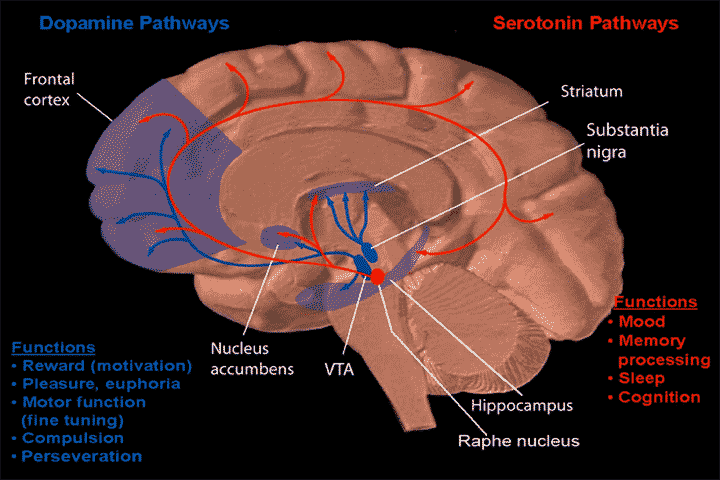
serotonin pathways

serotonin pathways

The above picture was taken from the link marked under “serotonin pathways” above. Dopamine is also included on this particular picture. The picture is excellent because it explains what functions dopamine and serotonin have and what they are responsible for. Note that neither indicates any connection to anxiety. In fact, in terms of anatomy, the areas responsible for anxiety are not even highlighted on any of these two pictures!

The questions necessarily arise: where are the anxiety sensitivity regions on the map? And if they are not connected to the depression part of the brain, why are anti-depression medications prescribed for anxiety?

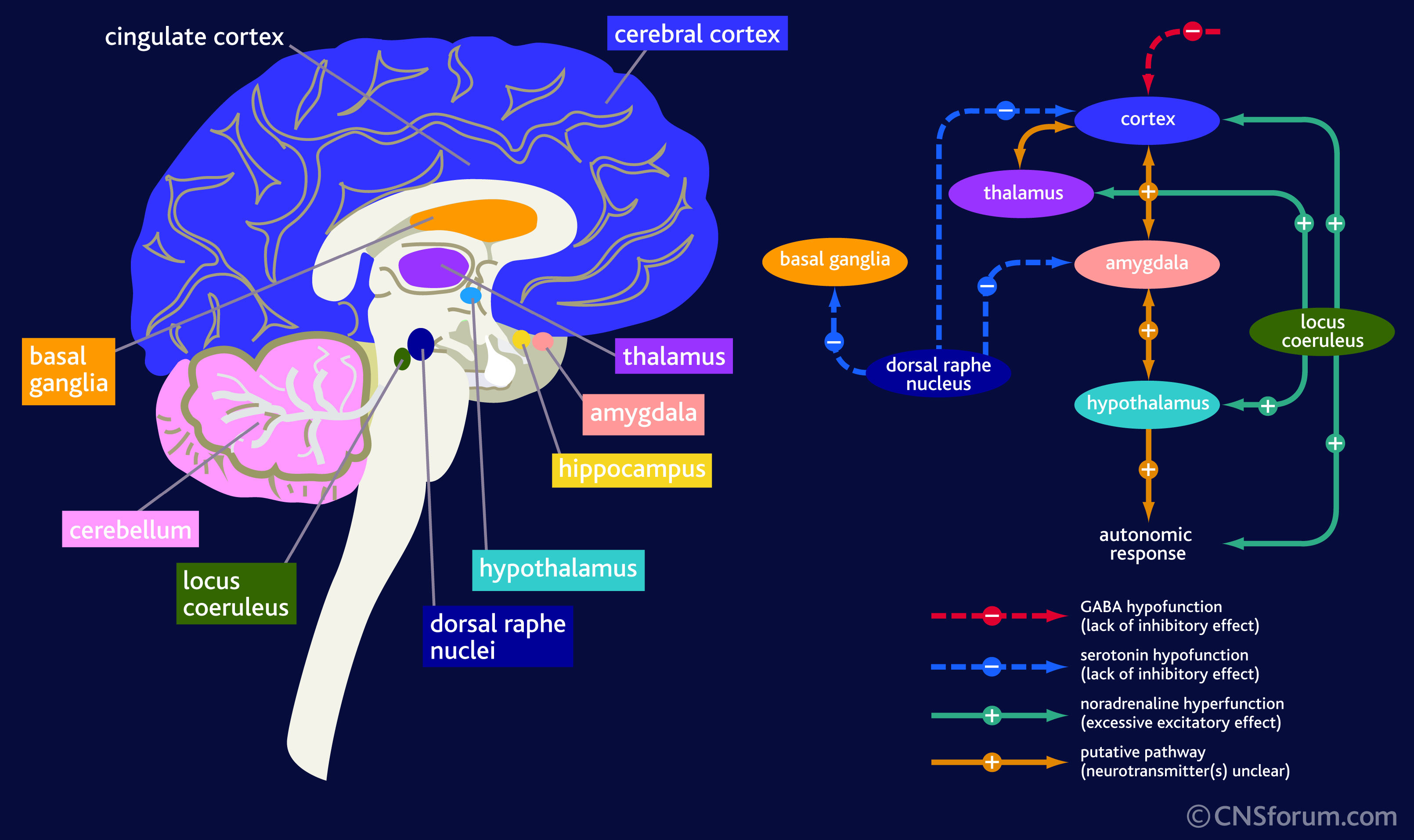
The areas of the brain in anxiety disorder are well discussed in this article and the picture below shows a good description of the anatomy and the flow direction of anxiety response, part of the same article, here I post separately in case you don’t want to read the above article linked to:

anxiety disorder picture

anxiety disorder picture

The picture above has 2 parts. On the left it shows of the many colors of various brain parts. One tiny green dot called the Locus Coeruleus is responsible for anxiety, which is an extension of the limbic system of the brain (often referred to incorrectly as the reptilian brain). Note that this particular part of the brain is separate from those that are affected by depression.

On the right there is an important table. It shows the path that anxiety takes as it manifests itself. It starts in the Locus Coeruleus and then heads into the cortex (blue), the thalamus (purple),  to the hypothalamus (light blue) and through the cortex also to the amygdala from which it passes to the hypothalamus and then to response. It also goes to a a couple of other places drawn in blue, one of which has a return arrow to the amygdala, considered to be the most important region of anxiety manifestation.

The first thing to note it that there is some connection to the serotonin pathway but also note that the connection is one directional in all except on small 3rd removed from the dorsal raphne nucleus! Meaning stimulus of anxiety will enter into the serotonergic pathway but serotonin will not enter the anxiety pathways much at all it is so removed!

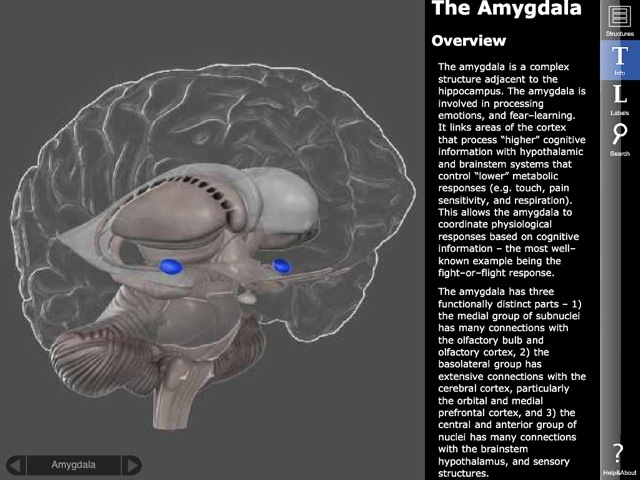
Anxiety is the dysfunction of a completely different hormone (neurotransmitter in the brain) called Noradrenaline (in common parlance that is adrenaline). Another picture where on a 3D image the area affected is better visible

anxiety in the amygdala

anxiety in the amygdala

On this picture above you can also read some of the descriptions about the importance of the amygdala in anxiety–marked with the two blue areas.

These pictures and analysis show that there really is no connection of significance between depression and anxiety. Most people I know who have anxiety (including me) are very happy people. There is no reason to give anti depression drugs when neither are they depressed not are they having problems with the part of the brain that needs serotonin. Why do doctors prescribe serotonin? The pharmaceuticals push the drugs. Now the FDA even approved psychotropic medications with serotonin for children as young as 8 years old, whose brains are  not even developed. The damage these drugs will cause in the brains of children is unimaginable! We are creating a whole new generation of brain-damaged people!

I noted at the beginning that sometimes serotonin does work for pains, such as migraine, where depression is not present but anxiety is. How is that possible? If you read my book–noted above–you will see that the cause of migraine is the lack of voltage in certain parts of the brain. It just so happens that in a large number of cases that brain region is associated with neurons that cannot function and those are neurons that normally manufacture serotonin. If then we provide serotonin to the brain, the pain will go away since the brain now sees serotonin and it cares little about an area that is not working. Serotonin did not cure the migraine; only it temporarily filled in the gap for those neurons that would normally make serotonin and now they cannot.

Other times when the serotonin drugs don’t work, it is because the areas affected by the migraine are not located in the anatomical area where serotonin is normally made and so adding extra serotonin is not helpful. Thus the pain remains.

In conclusion: giving serotonin and SSRI drugs to a whole variety of unrelated illnesses (migraine, fibromyalgia, bipolar, anxiety, dementia, ADD, ADHD, etc.,) obviously could not be useful for treatment. Most often these drugs are prescribed off-label, which I have already complained about since that is experimenting with humans without consent.

Many doctors tell me that they do not like to prescribe anti anxiety drugs, benzodiazepines, because they are addictive and affect memory. But they forget (or shamefully perhaps don’t know) that serotonin drugs cause even more dependence, some cannot ever be stopped, and that they cause serious brain fog and memory problems and sometimes death by serotonin syndrome (toxicity).

Atypical benzodiazepine receptor ligands

I wanted to spend a moment on explaining something about Benzodiazepines that confuses most doctors–especially “atypical benzodiazepine receptor ligands.” I have been told by several psychiatrists that ligands like Ambien or Lunesta or others are not benzos and therefore they are acceptable to prescribe when they disagree with the prescription of benzodiazepines otherwise. In this section I would like to provide an explanation about what “atypical benzodiazepine receptor ligands” are and how they work because they are listed under benzodiazepines for a good reason!

The term “atypical” is probably clear; “receptor ligand” is the part that confuses many doctors because these refer to a chemical behavior that combined with the word “atypical” may suggest that these drugs are not benzos. Indeed they are not in terms of molecular structure but does that mean anything relevant? Atypical benzodiazepine ligands are listed under benzos! So how does that happen if they don’t work like benzos? 

Let me quote two sentences out of a scientific research article that can be found at the NIH PubMed website if you have an account. The title of this article: Sleep pharmacology of typical and atypical ligands of benzodiazepine receptors. Not surprisingly, the following is stated in the abstract and proved all through the paper: “The results of these experiments indicate a heterogeneity in the mechanism of action of benzodiazepine and non-benzodiazepine ligands of benzodiazepine receptors, because they affect differently the various components of sleep. It is not necessary to invoke a heterogeneity of the central benzodiazepine receptors (the BZ1-BZ2 theory) in order to account for these differences, but they can be explained by the concept of spare receptors.

So let me translate a bit so you understand what these two sentences actually mean and why they are important. In the nervous system, the neurons work by using their receptors to take in various neurotransmitters. Some of these receptors only handle one particular compound (like Oxytocin) while others, such as serotonin accept just about any molecule that is snug enough, even if not a perfect fit. When a receptor accepts a molecule of any kind, given that it is a receptor for serotonin for example, even it is has accepted a sand molecule, it activates serotonin release or blocking because the sand attached to a serotonin receptor. In other words what matters is where it connects and not what connects. This is important because of what ligands are.

Ligands are imitators and impersonators of the molecular world. Use a ligand to sleep instead of a benzo and you sleep just as well. The receptors have connected to different molecules, one to a Valium for example and in the other instance to an Ambien, but the outcome is the same: the benzodiazepne receptor was activated by the ligand and hence the brain works as if it received benzo. Doctors who believe that atypical benzodiazepine receptor ligands don’t act like benzos are mislead by the definition that simply describes their molecular structure and not what they do. They act as benzos and thus they behave and become benzos.

Do you still believe Benzodiazepines are worse than Serotonin drugs? 

What is the reason for the exchange from good benzodiazepine to bad serotonin or SSRI drugs? Is it that the pharmaceuticals pay more perhaps if you prescribe those? Or are doctors not educated right? I believe that SSRIs do more damage than good. I have yet to meet a single person for whom it worked and I know thousands who take it, or used to take it. I know hundreds who are trying to quit it and are having a really difficult time. I know many who ended up with serotonin syndrome (toxic levels of serotonin) and one I knew even died. I find it amazing how clueless our medical doctors can be and still prescribe serotonin in any shape or form!

It is time we all stood up and told them that we know better! We must take our health into our hands! If we want to live to a ripe old age and have a great retirement, we better tell our doctors to stop and listen because we know the truth! No more serotonin in any form please unless it is truly indicated in “clinical depression.” In no other condition can serotonin in any shape or form be prescribed for us! And I have yet to meet a person who has the real clinical depression because chances are they are not out doing their shopping or chatting on the internet. I believe that a very large percent of the people receiving serotonin today have no clinical depression if they have depression at all!

Comments are welcome!

Angela

Posted in Interesting reading, Migraine-Blog, Must Read, This & That, Thoughts | Tagged , , , , , , , , , , , , , , | 14 Comments

The Medications We Take; the Scam!

This is a video trailer that was sent to me by a friend who is a documentary film maker. The video itself is 45 minutes long; the trailer is just 3 minutes but very powerful. Well worth your time to watch!

The most powerful thing about it is that everything it says is true. In fact one of the psychotropic medications shown was one of the medications that killed my mom. The reason why I am posting this trailer is that I manage a migraine group of Facebook and participated in other migraine groups as well. Every time the opportunity of taking a pill comes up, instead of taking good care of the body, people rather opt for the pill.

Why are we obsessed with the pills? What is it that wants us to take pills on top of pills every day instead of simply stopping to eat sugar or sugar substitutes? Are we such weak people that we even need to take our salt in a pill rather than in our food or as a pinch if we must? Are we taking Vitamin D3 instead of going to the sun? Are we taking calcium supplements instead of drinking milk?

Why are we obsessed with pills? What exactly do these pills do to us? Some of these questions are answered in the 3-minute trailer. I suppose if you purchase the 45-minute version, it will give you even more detailed information–I do not have that copy.

I sure hope this 3-minute video will help you change your mind and make progress toward quitting pills and will encourage you to take your health into your own hands. Most importantly I hope this video will help you see the light at the end of the tunnel!

Comments are welcome,

Angela

Posted in Must Read, This & That, Thoughts, Videos | Tagged , , , , , , | Leave a comment

Are You Thirsty All The Time?

Most medical practitioners will tell you that if you are thirsty all the time it means you may have diabetes. While diabetes does come with that first sign, something much simpler is also happening that no one is ever talking about!

Let’s look at the biochemical nature of thirst; shall we? I will not get into chemical equations, have no worries. I just merely want to visit the cell level. When a cell doesn’t get water inside of it or lacks water on its outside, we feel thirsty. So the medical industry tells you “go ahead, drink some water.” But we have a problem. Each cell has openings (gates) that are closed unless something will open them.

The little video below shows you how the gate opens and closes. I call these gates “mouths” of the cells for simplicity. A cell must be able to open its mouth to get water in. The opening requires sodium and chloride (salt in common knowledge) since sodium (Na+) and chloride (Cl-) are opposites in charge in ionic form (they are in ionic form in the body). Opposites attract so in order for them to get closer, they send a shock of electricity through the cell, which opens the gates (mouths). When the gate is opened, sodium can go in (chloride stays out) and potassium also goes in. Hence the name: sodium-potassium gate–or pump. The video below is not created by me but is linked from Youtube.


If the gates cannot open, you can drink as much water as you wish but they will not be able to quench your thirst; water will not be able to enter the cells. Thus you can drink until the cows come home and you will remain thirsty!

As the video above shows, when you are thirsty, you first need to have enough salt in you to break down into sodium and chloride to open the gates and also enough potassium. Potassium is a diuretic, so it is needed to release the toxic used water from the cell whereas sodium grabs fresh water as it enters the cell. When the cell is in balance this way, it can refresh its water as it needs to and so you will not feel thirsty.

Thus if you know you are not diabetic but you are thirsty all the time, instead of grabbing a glass of water, grab a little salty something AND a glass of water. Particularly if you are in a very hot region or exercise a lot, you evaporate sweat water and salt with your body’s cooling system as it cools itself. You need to replace water AND salt, not just water. Drinking too much water without salt can harm you in what is called water toxicity! Be aware that soft drinks, teas, coffees, and alcohol are not hydrating and are not equal to water! When thirsty, have some salt and water. And by water I mean WATER!

Which salt should you eat? I have several articles on salt in this blog and if you page back to the types of salts I wrote about, you will learn that white salt is what you want and purified kind–I know, there are all kinds of advertisements and articles on natural sea salts but of course, everyone wants to sell something. In just one sentence: every salt on earth is sea salt, and that includes your table salt to the Himalayan salt coming from the top of the mountain. All are sea salts. The difference is how much gunk they carry. Natural unpurified salts carry a lot of trace minerals that many sellers are proud of but in reality most are radio-active so be careful! Read the article and see the list of radioactive ingredients in the Himalayan salt at the link provided. Other salts have the same with varying degrees. Table salt is purified specifically to get rid of the radio-active materials.

So thirsty? Have some salt and then water. 

Comments are welcome.

Angela

Posted in Migraine-Blog, Must Read, This & That, Thoughts, Videos | Tagged , , , , , , , , , , , , , | 5 Comments

Are You Always Craving Sweets? Sugar Substitutes & the BIG Secret!

I cannot tell you how often I hear “I have a sweet tooth” or “I crave sugar all the time” or “I cannot stop eating sweets” or “I eat sweets when I am depressed” etc. Why do we have sweet tooth? Have you ever given that a thought? What does that mean? Does it mean anything? Indeed it does! So listen up!

I am starting with sugar substitutes and then move to sugar:

Are you eating sugar substitutes because you don’t want to gain weight, or because you have type 2 diabetes (T2D) and you crave sweets? Sugar substitutes can actually create T2D. Did you know that?

I read many books and articles on the subject of sugar being bad for you but most forget to explain 2 important things.

1) Insulin is released from the taste (smell, sight, and thought) of sweet and not sugar. Thus taking in sugar substitutes, because they are sweet, release insulin just like real sugar

2) Insulin resistance (same as T2D) develops from the insulin floating in your blood looking for sugar to deposit. Your body ignores insulin since because there is way too much to be put into the cells and they cannot handle it.

The job of insulin is to take the sugar in your food and deliver it to cells or convert it to fat, deposit it for later use in the body for energy. When the tongue tastes sweet, the body releases insulin immediately in search of finding the sugar and convert it for later use as energy. The problem is that since it doesn’t find any sugar if you eat naturals or sugar substitutes, sugar rash, excess insulin, as described above, kicks in plus you are hit with sugar cravings since your body thought it was getting sugar but it didn’t!

If you eat no carbs, no vegetables with carbs like potatoes, no fruits, your brain sees no sugar at all and it kicks in the sugar crave. If you eat/drink sugar substitutes, the more of those you eat, the more your craving for sugar will increase since your body is getting loads and loads of insulin that is takign the glucose from your blood, causing a sugar crash. So you need more glucose, which never comes!

This also kicks in the starvation mode by the brain so you will stop being active–it is not your choice; the brain is the control center here. The brain orders you to be resting because it has no sugar to keep your temperature constant, your heart beat constant, etc. The brain puts you into starvation mode, which reduces metabolic rate and that can lead to obesity. Smaller amount of foods will convert into energy in your body slower.

Now about the real sugar:

OK you say, I will now stop eating fake sugar and start eating the real one! But we have a problem. Table sugar is 50% fructose and 50% glucose. Fructose is found in fruits. Fructose is acceptable in small amounts for you as long as you eat it with fiber because it diverts it from the liver, where it is converted into ethanol (alcohol) and then triglycerides. causing non-alcoholic fatty liver disease (NAFLD)–fructose is very unhealthy. Fiber is essential for the bacteria in your gut. If you are not eating fiber but drink fruit juice for example, the fructose just hits the liver full force, creating NAFLD. It is also problem for your gut since now there is no food for the bacteria (fiber) so they die off or the kind of bacteria that is not beneficial will increase, causing SIBO or candidas. So what do we now do? Definitely don’t eat probiotics (bacteria)!

You can eat good bacteria forever. If you don’t eat insoluble fiber, they will not survive. Insoluble fiber is the most difficult food to eat since they are hard and tough and are indigestible. Insoluble fiber is soft-bark and our digestive tract is not made to digest it. Another form of fiber is soluble fiber. Most fiber supplements are soluble fiber. They are “prebiotic” since they support bacterial growth though not fermentation, which is the most essential for us, humans.

So what kind of sugar should we eat? And is it something we should eat at all? There is no consensus on how much refined sugar or fructose without fiber (like fruit juice or peeled fruit) one can eat. Given that they end up in the liver as ethanol causing harm over your lifetime and build up (ethanol does not leave, most of it collects and stays there), my personal recommendation is NONE.

I too am addicted to sugar just like everyone else and am slowly cutting it out of my diet. But I dumped already all foods with added sugar. For any sweet cravings, I eat a piece of fruit with skin and high fiber–raspberries are great for that–or vegetables–carrots are great. I no longer eat processed food, no sweets of any kind, I don’t eat bread or crackers for the sweeteners they put into them. I drink no soft drinks at all, no alcohol at all (alcohol is fermented sugar!). I avoid anything added sugar like the plague. I go at least 10 feet distance away from any artificial sweeteners! I recommend you do the same!

Comments are welcome!

Angela

Posted in Migraine-Blog, Must Read, This & That, Thoughts, Videos | Tagged , , , , , , , , , , | 8 Comments

Clueless Doctors Robin Williams’ Style. Rest in Peace!

The power of medicines and what you don’t know can and will hurt you. Cluelessness has no end. No one can say it better than Robin Williams did.

Robin Williams on medicines


Posted in Introduction, Migraine-Blog, Videos | Tagged , , , , , | Leave a comment

What Salt Are You Eating?

All About Salt

Salt, sea salt, table salt, Himalayan salt, Celtic sea salt, pink salt, gray salt, brown salt, etc. Do you know which is what and which you should be eating? The question is for real.

Quick: how many of you think that there is a difference between salt and sea salt?

The question is an important one and I want to spend a little time talking about the various salts–though I already talked about the importance of salt before, I did not say which salt and why. I know that many people today buy “sea salt” and a lot of people are now starting to get Himalayan salt, Celtic salt, Mediterranean sun evaporated sea water salt that is still moist and others just eat table salt. Is there a difference? Which is better for you and why?

In previous blogs I discussed that salt is made of 2 elements: sodium and chloride, with the chemical formula being NaCl where NA is a positive ion and Cl is a negative one. Together they keep our cells healthy when water is added, because they create voltage that helps the cell open its pumps and gates (its mouths if you will) to exchange nutrients and expel toxins.

So in reality, the salt your body needs is just that: sodium and chloride and nothing else.

All Salts are Sea Salts

Let me first answer the question if there is any difference between salt and sea salt: no. All salt on this planet is sea salt. Why the difference in name? It is a fad and some smart companies realized that if they put the word “sea” in front of “salt” people will buy more and they were probably right. People tell me all the time that sea salt is better in general and healthier than salt not realizing that the common table salt is also sea salt. It could be mined from the top of the Himalayan mountains. At one point that cave on the top of that mountain was under the sea and it is sea salt. So let me repeat all salts are sea salts.

So then what is the big fuss about the different colors, textures, naturally evaporated and still most, etc. Well, it is a dirty little secret. Hard to find out what is actually contained in a particular salt when it is not white since by nature pure sea salt is white and each crystal is transparent like glass. So if your salt has any color other than white and it is not transparent, it has something in it but what? Few salt manufacturers detail what is in their salts.

Take for example Celtic sea salt. I searched and the most informative site on the web still does not tell one what those magical vital 82 trace minerals are in the salt but it explains that they evaporate the water gently and leave a bit of moisture behind so the salt remains moist. They also explain that its color of the underlying grayish brown is the mud from the sea floor. So there is mud in your salt–this is why they must keep it moist else you would need a hammer to break your salt up. That is one problem. The other is what that mud contains. I am not sure if you know what falls to create the mud on the bottom of the sea floor and without being very blunt, let me just say I am glad fish and other creatures do not use toilet paper or coffins.

The minerals are secret though. However, a friend in the UK found a link of the trace minerals in the Himalayan salt and that I can link to and show you what may be in Celtic and other salts that are not white and pure. The Natural Pink Himalayan Rock Salt has an amazing list of trace minerals–and remember “rock” salt is still sea salt that has been out of the sea for long enough to have become rock-like from the pressure (indeed, it is fossilized salt):

Element Symbol Analysis Type
Hydrogen H 0.30 g/kg
Lithium Li 0.40 g/kg
Beryllium Be <0.01 ppm
Boron B <0.001 ppm
Carbon C <0.001 ppm
Nitrogen N 0.024 ppm
Oxygen O 1.20 g/kg
Flouride F- <0.1 g/kg
Sodium Na+ 382.61 g/kg
Magnesium Mg 0.16 g/kg
Aluminum Al 0.661 ppm
Silicon Si <0.1 g/kg
Phosphorus P <0.10 ppm
Sulfur S 12.4 g/kg
Chloride Cl- 590.93 g/kg
Potassium K+ 3.5 g/kg
Calcium Ca 4.05 g/kg
Scandium Sc <0.0001 ppm
Titanium Ti <0.001 ppm
Vanadium V 0.06 ppm
Chromium Cr 0.05 ppm
Manganese Mn 0.27 ppm
Iron Fe 38.9 ppm
Cobalt Co 0.60 ppm
Nickel Ni 0.13 ppm
Copper Cu 0.56 ppm
Zinc Zn 2.38 ppm
Gallium Ga <0.001 ppm
Germanium Ge <0.001 ppm
Arsenic As <0.01 ppm
Selenium Se 0.05 ppm
Bromine Br 2.1 ppm
Rubidium Rb <0.04 ppm
Strontium Sr <0.014 g/kg
Ytterbium Y <0.001 ppm
Zirconium Zr <0.001 ppm
Niobium Nb <0.001 ppm
Molybdenum Mo <0.01 ppm
Technetium Tc N/A unstable isotope
Ruthenium Ru <0.001 ppm
Rhodium Rh <0.001 ppm
Palladium Pd <0.001 ppm
Silver Ag 0.031 ppm
Cadmium Cd <0.01 ppm
Indium In <0.001 ppm
Tin Sn <0.01 ppm
Antimony Sb <0.01 ppm
Tellurium Te <0.001 ppm
Iodine I <0.1 g/kg
Cesium Cs <0.001 ppm
Barium Ba 1.96 ppm
Lanthanum La <0.001 ppm
Cerium Ce <0.001 ppm
Praseodymium Pr <0.001 ppm
Neodymium Nd <0.001 ppm
Promethium Pm N/A unstable isotope
Samarium Sm <0.001 ppm
Europium Eu < 3.0 ppm
Gadolinium Gd <0.001 ppm
Terbium Tb <0.001 ppm
Dysprosium Dy <4.0 ppm
Holmium Ho <0.001 ppm
Erbium Er <0.001 ppm
Thulium Tm <0.001 ppm
Ytterbium Yb <0.001 ppm
Lutetium Lu <0.001 ppm
Hafnium Hf <0.001 ppm
Tantalum Ta 1.1 ppm
Wolfram W <0.001 ppm
Rhenium Re <2.5 ppm
Osmium Os <0.001 ppm
Iridium Ir <2.0 ppm
Platinum Pt <0.47 ppm
Gold Au <1.0 ppm
Mercury Hg <0.03 ppm
Thallium Ti <0.06 ppm
Lead Pb <0.10 ppm
Bismuth Bi <0.10 ppm
Polonium Po <0.001 ppm
Astatine At <0.001 ppm
Francium Fr <1.0 ppm
Radium Ra <0.001 ppm
Actinium Ac <0.001 ppm
Thorium Th <0.001 ppm
Protactinium Pa <0.001 ppm
Uranium U <0.001 ppm
Neptunium Np <0.001 ppm
Plutonium Pu <0.001 ppm

This table is copied from the site linked to above under the salt itself. I don’t know how familiar you are with some of these elements but let me grab just a few. Of course these are trace, meaning very tiny, so their effects are also minimal per serving–in the table noted per kg salt consumption. Still over many years of use or your lifetime, eating salt of this kind many times a day, some of these elements build up and hurt you.

Plutonium: are you planning to build a nuclear reactor?

Iridium, Radium, Neptunium, Uranium, Protactinium, Thorium, Actinium, Francium, and I could continue are all radio-active elements, some more than others.

Ingesting radioactive elements is dangerous. It is particularly dangerous if you are not consuming iodine in the right quantity to help your thyroid clear the radiation from your body.

You recall I also wrote an article on the importance of iodine in salt if you still have thyroid and if you are not suffering from Hashimoto’s or Grave’s diseases, in which case iodine can hurt you. Note that there is a trace level of iodine in this particular salt as is in all sea salt because of the fact that dead organic matter collects on solid objects in seas and oceans and many sea organic beings, kelp, etc., do have iodine in them as well. But the amount falling on the on salt crystals (they are not crystals in water but molecules) and remaining there is very tiny.

Your entire body and not just the thyroid needs iodine. The NIH (National Institute of Health) in the US recommends the following iodine levels:

Minimum Iodine Necessary

Life Stage

Recommended Amount
Birth to 6 months 110 mcg
Infants 7-12 months 130 mcg
Children 1-8 years 90 mcg
Children 9-13 years 120 mcg
Teens 14-18 years 150 mcg
Adults 150 mcg
Pregnant teens and women 220 mcg
Breastfeeding teens and women 290 mcg

Upper Limits on Iodine

Life Stage                                            Upper Limit

Birth to 12 months:                      Not established

Children 1-3 years:                       200 mcg

Children  4-8 years:                     300 mcg

Children 9-13 years:                    600 mcg

Teens 14-18 years:                       900 mcg

Adults:                                         1,100 mcg

(table updated on 3/24/2018 to reflect new guidelines, which now contain upper limits).

On the mineral list of the Himalayan Pink Rock Salt above you can see that the amount is less than (<) 0.01g/kg which is less than 10,000 mcg per kg.  1 kg is 35 oz approximately. Based on the US recommended daily sodium recommendation (after significant calculation and conversion between metrics), the daily amount ingested from Himalayan Pink Rock Salt is less than 5.7 mcg which is a very small fraction of what one needs. Check out the entire page on NIH why iodine is important even in brain development!

You may recall the earthquake in Japan followed by the tsunami that wiped out the nuclear facility there. The first item sold out in stores after the nuclear explosions was iodine. Iodine can help clean your system from toxins, even radioactive ones. It can save your life.

So with all this I ask why would anyone eat salt that is not purified like table salt is? Most people tell me that in the purification process everything is taken out of the salt and so it has no additional things in it! Precisely! That is the good thing about it! Just add iodine!

So next time you evaluate what salt you should eat, take iodized salt that is white and each crystal is clear like glass! That is the purest salt you can get. If you want to eat iron, eat spinach and red meat. If you want to eat radiation, visit Chernobyl.

Comments are welcomes as always, and are moderated for appropriateness.

Angela

Last updated: 3/24/2018
by: Angela A Stanton, Ph.D.

Posted in Healthcare, Interesting reading, Must Read, nutrition, This & That, Thoughts | Tagged , , , , , , , , , , , , , , , , , , | 32 Comments