
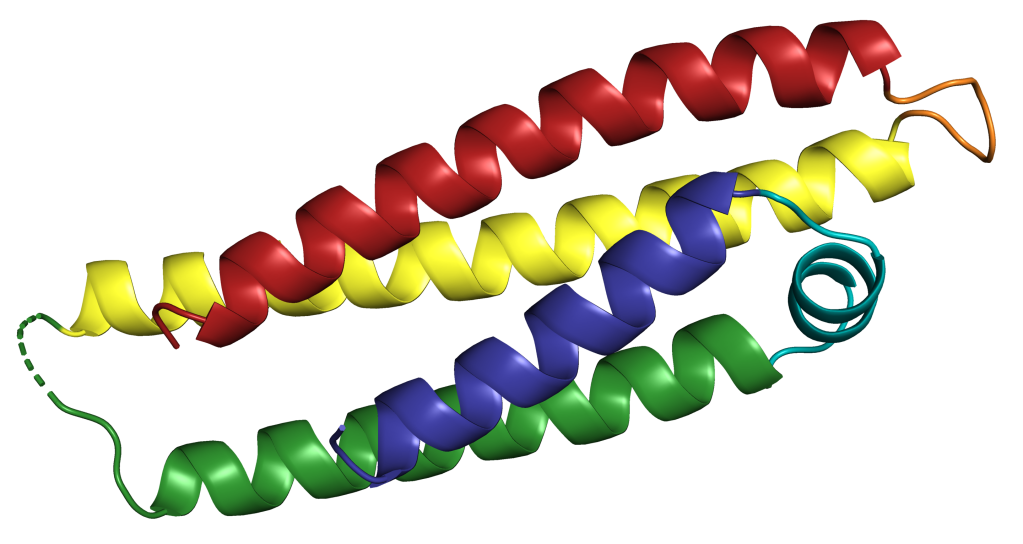
Image from: https://www.rcsb.org/structure/1B68
The Truth About Alzheimer’s Disease
APOE Genes & Their Connections to Alzheimer’s Disease
It is often noted that APOE4 is a genetic variant that is associated with Alzheimer’s disease. The apolipoprotein E (APOE) gene is a gene that provides instructions for making a protein that helps move cholesterol and fat in the blood and enhances immune function. But there is a problem with the initial setup of what the APOE gene does and what the various types (APOE2, 3, and 4) mean.
We all inherit one of these genes from each of our parents, so we may be any mix of APOE2, APOE3, and APOE4, meaning APOE-2/2, -3/3, -4/4, -2/3, -3/2, -2/4, -4/2, -3/4, and -4/3.
It is also often said that the APOE4 is a gene that prevents the proper use of fat and cholesterol in the body and hence the formation of the Amyloid plaques and the Tau beta cells. But is this really correct or is it backwards completely?
In order to understand this, we need to review the evolution of the APOE gene and the ancestral human diet.
Human History
Humans have been scavengers and meat eaters for millions of years, with “Homo habilis” considered as the first hominin to regularly consume meat 2.6 million years ago. There weren’t many veggies available since most of the vegetables we humans eat today evolved much later. Most of what humans ate were meat, fat, bone marrow, and seasonally nuts, seeds, wild fruits, and roots/tubers. We believe that the paleolithic human may also have eaten legumes and plants like wild mustard (the family from which about 500 years ago all of the cruciferous veggies were derived), nettles, and flowers.
We can’t be sure how much of these our human ancestors had access to since plants are seasonal and geographically variable, plus some, such as legumes, are quite toxic without proper preparation. Furthermore, from 300,000 years to about 12,000 years ago there was an ice age, in which most of the areas north of 35-degree latitude would have been frozen most of the year and only tundra type vegetation was available year around. Yet some humans left Africa about 2 million years ago, so modern humans, Neanderthals, and Denisovans were on the European continent during the ice age, where there weren’t many plants available to eat. Archeological evidence points to humans mostly eating meat, fat, and marrow at this time.
So it makes sense to have an APOE gene that allows for proper metabolism of fat and cholesterol. And this is the time the APOE4 was the dominant gene. So the APOE4 gene must be at least 2 million years old. And, indeed, it is 3-7 million years old. It is found in chimpanzees and other primates as well. In fact, chimps have only the APOE4 gene to this day! While chimps don’t eat much meat—not because they don’t want to but because they are limited in killing ability for it—they get a ton of fat in their food!



 neurologist gave no advise or info. If it were not for this Doctor and this website , I may be dead. Thank you.











 Clueless Doctors & Scientists