

Art created by Angela A. Stanton, PhD.
- The EAT-Lancet: Our Worst Nightmare
As defined by its authors, EAT-Lancet is a “new evidence-based insight on nutrition and human health, within safe and just planetary boundaries”. Once I crossed everything out that it is not true, this is what remains: “Eat-Lancet is a new insight within planetary boundaries”. There is absolutely nothing evidence-based in what they present, nothing focuses on true human health and nutrition, and nothing is safe and just. Let me hammer the Eat-Lancet 2.0 into a heap of dust by discussing some of its main tenets.
Read the 68-page article, titled “Meat vs EAT-Lancet: The dynamics of an industry-orchestrated online backlash”, a published (see here) analysis of “mis-influencers”. The entire publication is a giant complaint about the scientists who are fighting against the EAT-Lancet, and a very scary detailed analysis of every step they take! This publication is just short of a call for action to get rid of these experts. The mis-influencers are those who actively fight against the EAT-Lancet. In my opinion it is the most shocking and dangerous paper ever published since WW2.
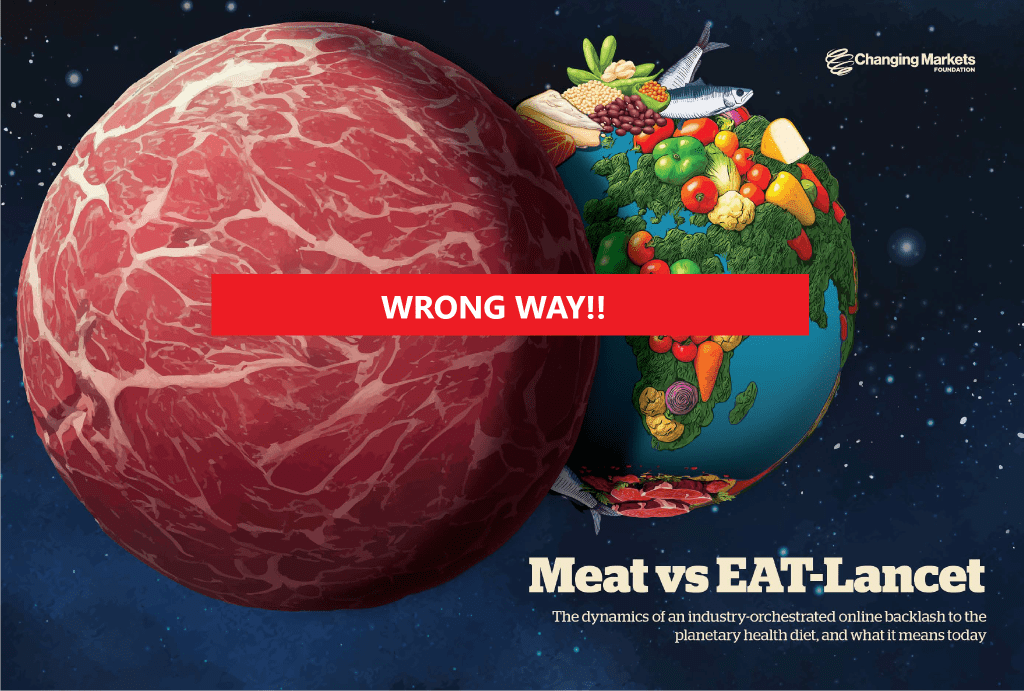
Image of the original cover modified by Angela A. Stanton PhD.
2. The cover page of the Meat vs EAT-Lancet.
In addition to being shocked to the core that something like this can publish anywhere in the year 2025, I am also greatly concerned about the direction in which it leads herding many nations—specifically the Nordic countries in Europe, but also others that entangled in the web of the EAT-Lancet.
My first head-butting with the EAT-Lancet was in 2019, when their 1.0 plan was released. If you are interested in my reaction to the 2019 release, I have several articles for you to read here, here, and here. See some of the resistance in the journal-published comments, here is mine.
In this blog, I am evaluating the most important points of the 2.0 edition EAT-Lancet, so you need not read the huge, 76-page monster full of nonsense.
The Focus of the EAT-Lancet
It treats food production as a static optimization problem, which seeks the best value (max or min) of an objective function that depends on variables that do not change with time. Here the question asked is: “how to feed 10 billion people with less land and lower emissions” — rather than as a dynamic ecological system with feedback loops (soil carbon cycles, ruminant symbiosis, nitrogen fixation, etc.). In other words: the EAT-Lancet is not a system-solution, just a solution to independent points in the chain of actions in a restricted system.
We need to maintain an unrestricted view. We can’t just remove animals from land without serious consequences for everything else in the chain. And we most certainly can’t just start growing crops on every available land because tilling the soil releases CO2—the very thing we don’t want to increase. Short-lived annuals with shallow roots destroy the top layer of the soil, not to mention that many large land areas all over the planet aren’t capable of handling crops because of location or soil or climate.
Fertilization supports plants but not the soil, which means that the life of the soil that helps plants take on nutrients won’t be maintained. This further erodes the soil until desertification follows.
These activities collapse the carbon, nitrogen, and microbial cycles that maintain fertility and carbon sequestration (see here, here, here, and here). Removing animals from the land not only hurts them but hurts the plants and us as well. And while the EAT-Lancet brings up pages upon pages of detailed explanation of what to do with the land, the soil, the animals, and the people, and how to do everything in the tiniest details, these points are completely hollowed out by lovely evaluation stories that are completely ignoring inconvenient facts. What follows is a list of things the EAT-Lancet left out of its manual.
The Killing of the Soil
Tilling releases CO₂
Tillage oxidizes soil organic matter and releases large amount of CO₂ in pulses during tilling time. Each major till event can release 0.3–0.5 tons (300 to 500 kilograms ) of carbon per hectare, depending on soil type (here, here, and here). Tillage is a widespread agricultural practice that disturbs the soil and causes the rapid decomposition of its organic matter. This process, also known as soil respiration, releases carbon dioxide from the soil into the atmosphere, contributing to climate change.
Continuous no-till regenerative grazing systems can sequester that carbon instead (see here, here, here, here, and here). EAT-Lancet ignores that their plan dramatically increases annual crop dependence — the opposite of a carbon sink. They criticize regenerative farmers that do not till and do not fertilize. Yet, if there are crops to be had, regenerative farms are the solution.
Short-root annual monocrops destroy topsoil (see here)
Annuals (wheat, corn, soy, rice, legumes) have root systems < 1 m deep, compared with perennials or pasture grasses (2–4 m). Annuals with their shallow root systems destroy the top layer of the soil. Perennial root mats stabilize soil, retain water, and host mycorrhizal networks (see here).
Artificial fertilizer vs. animal fertilizer
Synthetic fertilizer feeds the plant, but manure and grazing feed the soil microbiome, which then feeds the plant. Without ruminant-derived manure and hoof aeration, microbial biomass and soil aggregation collapse. The EAT-Lancet plan ignores nutrient recycling and it treats manure as waste rather than as the central node of ecosystem health.
Protein density and resource paradox
Legume protein has ~60–70 % digestibility and its bioavailability is often even less, whereas animal protein digestibility and bioavailability is close to 100%.
To reach the leucine threshold (~3-4.5 g bolus amount per meal, age and physical activity dependent) for muscle protein synthesis, one needs 50–70 g of legume protein versus 30-40 g of beef.
The land/water/energy input per gram of usable amino acid is far higher for legumes when full life-cycle costs are considered.
Another interesting paradox was brought up as an example: filling up a truck with cereal vs ground beef:
Example: Cheerios (typical boxed cereal) vs 80/20 ground beef
Assumptions for the Semi-Truck:
- Standard 53-foot trailer
- Max payload capacity: ~45,000 lbs (20,400 kg)
- Assume full loading volume or weight (whichever is limiting)
Cheerios (Dry Cereal)
Nutritional Density per 100 g (dry weight):
| Macronutrient | Value |
| Calories | 375 kcal |
| Protein | 7.9 g (not bioavailable just total protein) |
| Fat | 6.7 g |
| Carbohydrates | 73.3 g |
- Bulk density of dry cereal (boxed): ~0.2–0.3 g/cm³ (very light and bulky)
- Assume ~20,000 lbs (9,070 kg) of boxed Cheerios per truck due to volume limits, not weight
Truckload Nutrition from ~9,070 kg Cheerios:
| Macronutrient | Value |
| Calories | ~34 million kcal |
| Protein | ~717 kg |
| Fat | ~608 kg |
| Carbs | ~6,650 kg |
Ground Beef (80/20)
Nutritional Density per 100 g (raw):
| Macronutrient | Value |
| Calories | ~254 kcal |
| Protein | ~17 g (100% bioavailable protein) |
| Fat | ~20 g |
| Carbohydrates | 0 g (negligible) |
- Density of ground beef: ~1.03 g/cm³ (very dense)
- Can load nearly the full 45,000 lbs (20,400 kg) — no volume limit here
Truckload Nutrition from 20,400 kg Ground Beef:
| Macronutrient | Value |
| Calories | ~51.8 million kcal |
| Protein | ~3,470 kg |
| Fat | ~4,080 kg |
| Carbs | ~0 kg |
Side-by-Side Comparison (Per Full Truckload)
| Metric | Cheerios | Ground Beef |
| (Truckload Weight | ~9,070 kg (wasted space) | ~20,400 kg) |
| Calories | ~34 million kcal | ~52 million kcal |
| Protein | ~717 kg | ~3,470 kg |
| Fat | ~608 kg | ~4,080 kg |
| Carbs | ~6,650 kg | 0 kg |
Takeaways
- Ground beef is far more protein- and fat-dense per kg, and per truckload, than Cheerios.
- Cheerios are primarily carbohydrates with far less usable protein or fat.
- A truck of meat is more than 4x as protein-dense and nearly 7x as fat-dense.
- From a caloric efficiency standpoint: meat wins.
- From a nutritional bioavailability standpoint: beef is vastly superior (high-quality complete protein, B12, heme iron, zinc, etc.).
Obesity
EAT-Lancet models rarely adjust for bioavailability — a major methodological flaw, which leads to obesity. High-carb, low-fat diets fail to trigger leptin/satiety signaling; people overeat to compensate for missing essential amino acids and fatty acids. While these diets meet caloric sufficiency, they fail to provide nutrient sufficiency, which leads to obesity most likely as a result of the reduction of metabolic speed (see here and here).
Increase ocean fish stocks by 47 %
This target is ecologically incoherent. Ocean biomass cannot be “grown” like crops—except in man-made farms, and we know how unhealthy that is for the fish as well as the environment. In addition, expanding industrial fishing fleets and shipping trucks, so they can harvest 47% more fish would increase fuel use, bycatch, and plastic/microfiber pollution and release toxins in the environment, causing road congestions. This shows a lack of understanding of marine ecology as well as a variety of industrial requirements.
Reduce Cows 47 %, Increase Milk 20 %
A perfect illustration of faulty thinking. Milk yield per cow is already near biological limits; further increases demand intensive grain feeding and hormone use, precisely what EAT-Lancet claims to oppose. So, either they rely on factory-style confinement (environmentally disastrous) or their numbers simply don’t reconcile.
EAT-Lancet’s Incorrect Views and Assumptions
“Eating animals is inefficient because energy is lost between trophic levels.” This statement violates both physics and ecology. In ecology, trophic levels describe the feeding positions in a food chain — essentially, who eats whom and how energy flows through an ecosystem.
| Trophic Level | Examples | Energy Source |
| 1️⃣ Primary producers | Plants, algae | Use sunlight → make energy via photosynthesis |
| 2️⃣ Primary consumers (herbivores) | Cows, rabbits, deer | Eat plants |
| 3️⃣ Secondary consumers (carnivores) | Wolves, lions | Eat herbivores |
| 4️⃣ Tertiary consumers (apex predators) | Humans (when eating animals), eagles | Eat carnivores or herbivores |
Trophic levels
Problems with EAT-Lancet’s logic
Misuse of thermodynamics: The EAT-Lancet suggests that energy disappears, which is impossible. In reality, energy is redistributed to maintain ecological balance (heat, motion, gases, microbes, soil fertility). The EAT-Lancet interpretation of trophic levels violates the First Law of Thermodynamics by treating energy as “lost,” and misapplies the Second Law by confusing entropy increase with inefficiency.
Wrong system boundary: They treat the food chain as a closed energy loop, but Earth’s biosphere is open because sunlight constantly adds new energy. The laws of thermodynamics don’t apply to Earth in isolation. It is meant to hold for the universe, within which planets, stars, etc., can exchange energy.
False equivalence of calories and nutrients: Not all energy is equal in biological terms.
100 kcal of glucose ≠ 100 kcal of fat ≠ 100 kcal of collagen, in terms of metabolic utility by nutrients.
Human biology uses high-entropy substrates efficiently: Humans evolved to extract energy and structure from already complex molecules (fatty acids, amino acids), so we don’t need to start from low-entropy plant cellulose like cows do.
Ruminants are energy transformers, not sinks. They convert solar energy locked in cellulose (inedible to humans) into dense, bioavailable nutrients humans need, a process of energy transformation, not energy loss.
Humans can’t eat most plant biomass. The “energy loss” from grass → cow → human doesn’t apply, because humans can’t digest grass or cellulose. Cows upcycle inedible plants into highly bioavailable protein and fat, nutrients humans can use.
Gaps in EAT-Lancet
Methane accounting distortion
Cattle methane is biogenic, part of the short carbon cycle, not fossil. Net warming effect negligible if herds are stable. However, there are very large methane releases by other natural elements, which are not mentioned or controlled by the EAT-Lancet and which really are the natural drivers of the increase of methane. These are:
1. Wetlands are the largest natural source of methane globally. Methane is produced by methanogenic archaea (anaerobic microbes) breaking down organic matter in oxygen-poor environments. Methane producers are swamps, marshes, peat bogs, and mangroves. Tropical wetlands emit the most methane.
2. Termites digest cellulose with the help of methane-producing microbes in their guts. It is estimated to contribute 1–3% of global methane emissions. Especially significant in tropical and subtropical ecosystems.
3. Oceans and Continental Shelves where methane hydrates (frozen clathrates, under sea beds), deep-sea vents and microbial processes in anoxic sediments and in some natural seeps.
4. Freshwater lakes and rivers are similar to wetlands, anaerobic decomposition in lake bottoms and sediments produces methane. Especially active in eutrophic lakes or oxygen-depleted zones.
5. Geological Seeps. Naturally methane vents from underground in fault lines, gas seeps, and volcano-adjacent zones occur. These are non-biological emissions from geologic methane reservoirs (thermogenic methane).
6. Wild Ruminants: deer, bison, antelope, moose, giraffes, etc. Just like cows, these ruminants produce methane through enteric fermentation. Historically contributed significantly before industrial cattle farming.
7. Permafrost in the Arctic Tundra is a large contributor to methane in the atmosphere. Thawing permafrost releases trapped methane and activates microbial methane production. Includes methane from: peatlands, melting clathrates, and anaerobic microbial activity in thawing soils
Land suitability:
Ignoring land unsuited for crops: ~40 % of Earth’s agricultural land is rangeland that cannot produce crops; removing grazing animals turns it into wasteland.
Seed-oil Health Problem:
Their plant-fat target relies on high-PUFA oils (soy, canola, sunflower), which have fragile supply chains and metabolic costs. High PUFA oils are unstable and oxidize very fast, making them into an inflammatory substance.
Socioeconomic fragility:
Many small pastoralist economies would collapse if animal husbandry were reduced by half. The EAT-Lancet ignores the cultural-economic layer.
What Will the EAT-Lancet Let You Eat?
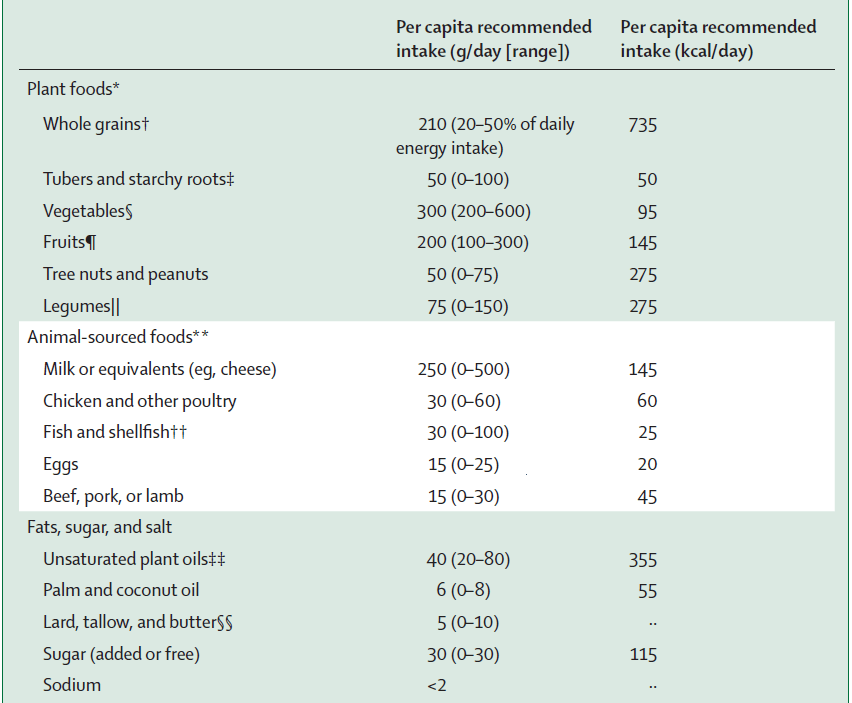
Table 2. Recommended portions
Table from Eat Lancet 2.0 Dietary targets for a healthy reference diet for adults, with possible ranges, for a population-level energy intake of approximately 2400 kcal/day.
Most of your food will be plants, which has low bioavailability, are high in antinutrients, and as I have shown, are much higher in cost and footprint than animal consumption.
“A cow can feed a village, but it takes an acre to grow enough beans for one person!”
As for the argument of the water-need per cow: if the cow is raised on a regenerative farm, where there is no watering of the fields, only drinking water is provided, for the life of the cow—about 2 years—vs growing beans to feed the same number of people for the same length of time as the life of that cow:
Beef cattle drink ~5–30 gallons/day, depending on heat, age, and weight. Over a ~2-year life, a cow may drink ~4,000–10,000 gallons total.
Compare that to the 814,000 gallons when including irrigated feed crops (corn, soy, etc.), which is where 95% of the water use typically goes in conventional systems.
So, which is a better food source? As you have seen, it is beef, in every single comparison!
Comments are welcome, as always, and are moderated for appropriateness.
Angela


 Clueless Doctors & Scientists
Pingback: The Vegan Lie | Clueless Doctors & Scientists
The Global Anti-Meat Conspiracy is alive and well, unlike the populations who might be seduced by the idiotic recommendations of EAT-Lancet 1.0 and 2.0. Thank you for having read the document and your efforts to debunk it as I would no doubt be apoplectic a couple of pages in.
LikeLike
Thank you for your comment Dr. Wortman.
LikeLike
As I am a Clinical Nutritionist, some of your thoughts on the EAT-Lancet propaganda are wrong. I am totally against the EAT-Lancet ideas since they first started the anti-meat push, so I am on your side! Calories from a nutritional point of view are an outdated concept and they don’t accurately reflect the health or nutrition of foods, nor how human bodies use and metabolise foods and nutrients at all! There’s a lot of reasons why calories should never be used in the area of foods and health, which I won’t go into here. Also, you have the wrong belief that CO2 is toxic and causes climate change, which is very much the WEF/globalist propaganda. CO2 is not an environmental toxin at all, but food for trees! The higher the CO2 level, the more trees and plants, as has been shown historically, and therefore more animals and more food! Plant growers know this and use CO2 generators to increase plant growth. Yes we are poisoning the environment with major mono crop agriculture, but CO2 is never the cause of global warming or climate change.
LikeLike
Dear Ross,
You wrote: “you have the wrong belief that CO2 is toxic and causes climate change” but you misunderstood my entire article! I don’t think CO2 is toxic–it is essential, just like cholesterol is… It is the EAT-Lancet that thinks CO2 is bad… not me. I merely explained that if they wish to reduce CO2, getting rid of cows won’t do that. This does not reflect my belief in the quality of CO2…
I also don’t support Calories use at all–I am not quite sure how you read that I do such… I think you speed-read my article without understanding.. perhaps a re-read will clear matter up for you. Perhaps you should also read my article of why counting calories is useless here, and here.
Best,
Angela
LikeLike