Thank You FDA!
This article was updated on 5/22/2019 with new FDA link to the quinolone warning label change by the FDA. Continue reading
This is how far we have come! An MD is not permitted to recommend a low carbohydrate diet for his type 2 diabetic patients!!!
Take a second look at what I just wrote: type 2 diabetes is caused by the inability of the body to process carbohydrates as a result of a compromised insulin system. The treatment is obviously to stop eating sugary fructose filled high sugary foods like juices, cakes, sweets of any kinds. In other words, high fructose implies “refined sugar” or “high sugar natural foods” in any shape and form. Yet in Australia a doctor is now banned from being able to advise his patients from reducing their carbohydrates by eliminating those with high non-essential sugars.
I have been writing now many times about how misled we had been over the past 80+ years and indeed, up until 30 years ago, diabetics (type 2) were actually recommended to increase their carbs (read Gary Taubes) but one would think that in 2016 we have become smarter than that! Apparently political interest trumps the health of people everywhere.
I am copy-pasting this important story from a Facebook page that is now run by the doctor’s wife Belinda Fettke
My husband, Dr. Gary Fettke No Fructose, has been silenced and so, from today, this page will become Belinda Fettke No Fructose
There has been an AHPRA [Australian Health Practitioner Regulation Agency] investigation into Gary’s qualifications to give nutritional advice and speak on the science of what we eat and its central role in our health. This investigation has been going on for over 2 years and a ‘caution’ has been proposed. Until the case is finalised he will have to abide by the law to maintain his professional registration, and to come back another day.
The Medical Board of Tasmania under the umbrella of the Australian Health Practitioners Regulatory Authority have advised him, ”In particular that he does not provide specific advice or recommendations on the subject of nutrition and how it relates to the management of diabetes or the treatment and/or prevention of cancer.”
Gary is not allowed to comment on the central role of nutrition in preventative health, nor in the management of chronic illness on any social media platform.
Gary has been silenced and cannot discuss nutrition with his patients in any clinical setting, regardless of any undue stress on joints before replacement, inflammation, or even diabetes complications requiring amputation.
Gary is not allowed to speak at any public or professional meetings that involve the discussion of nutrition.
It is IMPORTANT to note: Gary has NOT BEEN CAUTIONED on what he has been advocating with regards to LCHF – Low Carbohydrate Healthy Fat living, nor in regards to lowering carbohydrate intake in diabetes management.
Gary has not been cautioned on what he has been advocating with regards to considering the health benefits of real food that is fresh, seasonal and local.
Gary has not been cautioned on what he has been advocating with regards to the central role of nutrition in health.
Gary has, however, been criticised that his interpretation of his ‘research into a topic’ is not the same as AHPRA’s.
Gary will be questioning the proposed ‘caution’ but until there is a final finding from AHPRA he will have to abide by the law and not communicate on Social Media and by inference, to his patients. That will be difficult for him as he sees the benefits every working day for his patients that adopt better eating habits.
This scenario has been similar to the case of Professor Tim Noakes in South Africa. Tim and Gary have been communicating regularly. The difference between the cases is that Gary has been judged behind closed doors and Tim’s has been in courtrooms.
Gary’s investigation was the result of an anonymous notification and throughout the process he remains unaware of the peers that are judging him. It seems a strange system, where you are guilty until proven innocent, but he hopes to have the opportunity to make representation at some time before the final judgement.
Unfortunately, at this time, AHPRA have determined that Gary, as a doctor must not continue to question the paradigm in an open forum. It won’t stop him researching though, and strengthening his knowledge base.
It concerns me that all manner of people can give advice on the internet, and by definition, I have become one of them.
I have been on this journey with Gary and have my own opinion on matters related to health. By qualification to comment, I have none. My previous work as a Registered Nurse is unlikely to give me any expertise, but, like so many people living the LCHF life, I have seen the benefits in myself and those around me for many others who have decided to Choose Health.
So, if you are interested in helping me continue to question the science, promote the role that Low Carb Healthy Fat principles play in both the management and the prevention of disease, and would like to help me be to become louder than ever before, please join me as the voice of No Fructose.
Remembering that it is now my voice, anything written/said is not to be taken as individual advice for health conditions. I would always encourage you to see your doctor or health professional to individualise treatment and lifestyle advice.
http://www.nofructose.com will similarly be taken over by me 🙂
My Declaration of Interest – I am the very proud Co-founder of Nutrition for Life in Tasmania. We offer face to face appointments at our clinics in both Launceston and Hobart, and regularly Skype clients in rural Tasmania and Interstate. We have the most amazing team of health professionals and support staff, and they are making a difference in people’s lives.
If you agree that this is totally wrong, follow the movement and do whatever you can to advance science by opening a few ears and removing some blinders! We are ready for getting our lives back healthy and not artificially being kept ill so we can take more drugs!!
Comments are welcome and sharing this page is highly appreciated!
Angela
In continuing my education about understanding fats and which is bad or good–because everything points against all of what dietitians or nutritionists tell us and the USDA recommends–I decided to hit all books and articles. It is not that I want to prove the USDA or the schools that teach nutritionists wrong (well.. yeah.. a little) but I actually want to know what I should eat!
I already know that saturated fat (animal saturated in particular) really helps migraines by my experience (even if nutritionists tell me it is bad for me) but I now wanted to understand the difference between fats in general for my regular health and not for migraines in particular.
We know that we have one fat type that is believed to be super good: monounsaturated fat. The chemistry is complicated so I leave that for another day but monounsaturated fats lower what we call the bad cholesterol (LDL) and increase what we call the good cholesterol (HDL) so that is #1 we need in our fat. This assumes, of course, that lowering LDL and increasing HDL is always a good thing, which is not true, but let’s make that assumption for now. This assumption is necessary because I know that 99.9999999% of the doctors reading this sentence are already lost. Why? Because we have particles in LDL (current blood tests for cholesterol do not test for particles!). The large particles are fluff and good so lowering LDL may mean we remove the good particles and leave all the small dense kind that are really the bad guys… yeah… ask for an NMR lipid test next time when you are at your doctor instead of a lipid panel for cholesterol.
Next we know that polyunsaturated fats are bad for us so we want fats that have as little as possible. Polyunsaturated fats are unstable and are the topic of the article I wrote on how the bonds break, how they become goo from heat, settle in your arteries, etc.
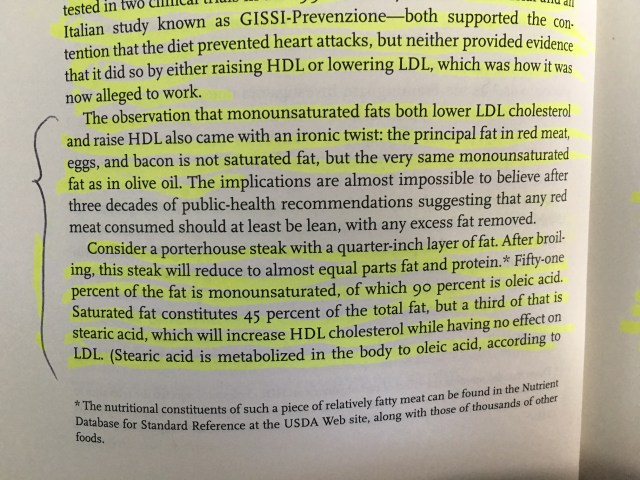
In reading Gary Taubes’ book “Good Calories, Bad Calories; Fats, Carbs, and The Controversial Science of Diet and Health” I found this section in the book very interesting and worthy to investigate:
I looked up in the USDA database the full nutrition information in order to compare the following fats:
Total saturated fat (a.k.a bad fat), Monounsaturated fat (a.k.a. good fat) and polyunsaturated fat (a.k.a. really bad fat) in the following food items: (100 gr = 3.5 oz) 100 gr porterhouse steak cooked, 1/8 inch fat; 100 gr avocado; 100 gr wild caught coho salmon cooked; 1 tablespoon olive oil.
Findings:
Fat Type Amount
Porterhouse Steak
total saturated fat 4.026
Monounsaturated 4.516
Polyunsaturated 0.513Avocado
total saturated fat: 2.125
Monounsaturated 9.799
Polyunsaturated 1.816Coho salmon
total saturated fat: 1.595
Monounsaturated 2.702
Polyunsaturated 2.5211 tablespoon olive oil
total saturated fat: 1.864
Monounsaturated 9.850
Polyunsaturated 1.421
Note that a tablespoon olive oil has more polyunsaturated fat (the really bad one) than a 100 gr porterhouse steak!
So what do you think I will be eating? Steak of course! Dumping my olive oil! I recommend you reconsider what food you enjoy!
Comments, as always, are welcome.
Angela
A couple of days ago one of my articles:
was published, which has created quite a stir on Facebook in some groups. I highly recommend you read it. The subject is very controversial:
This article explains how we had been misled for over 80 years about the health benefits of saturated animal fats (yes, political interests but I do not get involved in that). I show you as well as possible in as simple words as I can what the problem is, why what we are told is not true and how you can change your life by simply dumping all your vegetable oils and statins.
Enjoy the read and comments are welcome, as always!
Angela
The majority of doctors today believe that there is such as a “healthy cholesterol level” but they are totally wrong. This is not “me” saying this but all the studies for the past 100 years that have been swept under the rug in order to sell statins. I am dead serious! So let’s talk about cholesterol.
Cholesterol is made of a chemical our body produces in its conversion of animal meats to Acetyl CoA and Acetoacetyl CoA. Acetyl CoA and I quote “…is an important biochemical molecule in cellular respiration. It is produced in the second step of aerobic respiration after glycolysis and carries the carbon atoms of the acetyl group to the TCA cycle to be oxidized for energy production” (source) and “Acetoacetyl CoA is the precursor of HMG-CoA in the mevalonate pathway, which is essential for cholesterol biosynthesis. It also takes a similar role in the ketone bodies synthesis (ketogenesis) pathway of the liver” (source). Note the term “ketone bodies” so those on the ketogenic diet have this readily available. Those on carbs burning diet do not and have to make it.
Cholesterol is not made from fat of any kind but it made as part of the cellular respiration, which is what allows you to live.
The second myth is that there is such as an ideal cholesterol level. Ideal to whom? For what? What actually does cholesterol do to decide if its production is ideal? So let me take the answer to this step by step.
1) Is there an ideal cholesterol level? – you bet except that no two persons have identical cholesterol ideal levels. Why? Because cholesterol has major functions in our body and depending on who you are and what you need your body to do to stay healthy, your level of cholesterol will vary. I explain below what cholesterol does.
2) Ideal to whom? Can we say that a male Marathon runner at age 30 needs the same cholesterol as a little old lady at age 95? No? Interesting. As per current today’s doctors they are the same. I think you can see that there is something wrong with that. Why that is I explain in the next point.
3) For what? Why does the body need cholesterol and how does it make it? We can use cholesterol when it is given (egg yolks, for example) or make our own from cellular respiration as noted above. Cellular respiration is VERY important because it actually does not mean “breathing” but energy production, which we call ATP.
A healthy cellular respiration produces exactly as much ATP as your body needs.
If you produce less you feel tired or sick and if you produce more you feel energized but if you don’t use that energy you may end up with a bunch of free radicals and get sick. So this is cellular respiration (not you taking a breath). Thus cholesterol is produced based on the activity level of your cellular respiration. So the 30-year old male Marathon runner will “make” more cholesterol but that says nothing about how much he needs! The little old lady at age 95 who sits in the wheelchair all day is not making so much cholesterol but is what she makes enough? Frankly: WE HAVE NO CLUE. Why? No one ever studied what a good cholesterol level is so we just don’t know.
Since Ancel Keys it has been assumed that we do not need cholesterol (and that cholesterol is made of fat!) and any research along the lines of its importance was trashed, not published, not funded, researchers fired as they always became the black sheep of the research community. Does this make sense? No, but it sure made and continues to make a lot of money for a few!
4) “But we know that high levels of cholesterol cause heart failures!” False. In autopsies of people with cardiac failures, the majority have low cholesterol (yes, exactly the opposite of what we have been told). That’s because even today doctors only look at total cholesterol and that is totally meaningless. People who show cholesterol deposits in their arteries and die as a result of heart issues have triglycerides in their arteries.
Guess how you get triglycerides into your arteries? 2 ways:
1) eating a bunch of sugar and refines carbs like flour and
2) having high BP caused by such triglycerides and too much sugary stuff, diabetes (diabetes and heart trouble are linked!).
High BP means the blood speeds at very high pressure and sugar makes the blood more acidic than it should be (blood is the only alkaline part of our body); it damages the lining of the artery and little tears appear. Triglycerides’ have a job in the blood: fix the tear! So yeah…. People who die of cardiac arrest will show atherosclerosis (cholesterol in the arteries) but they all will be triglycerides, caused by high BP that is caused by eating too much refined carbs and sugar.
No! Especially not if you don’t eat refined carbs and also complex carbs without fiber–like if you eat an apple with the skin on that is great. Drink the apple as a juice or smoothie or shake or eat it as a sauce and you are building triglycerides! Not so great!
5) What does cholesterol do so we can evaluate if it is ideal or not in its levels? So finally, in case you want to know why we even have cholesterol: cholesterol is THE most important thing in the human body. First of all, all of the cholesterol in our body has a healing function. 25% of all cholesterol we have is in our brain in the “white matter” where it is myelinating our brain cells so we can fire voltages without leaks—leaks cause seizures and plaques that lead to brain damage. We also know that this myelination process allows smooth voltage firing and helps in migraine management.
The other functions of cholesterol are as follows:
a) cholesterol creates what is called Coenzyme Q10 (CoQ10). CoQ10 is the base of mitochondrial energy creation. As I noted earlier, cholesterol’s basic material is created by cellular respiration: CoQ10 is the 1st through 3rd steps of this cellular respiration. If you take statins, you cannot make CoQ10 and your cellular respiration is shot, mitochondria damaged. This is why the FDA put warning label on statins about muscle damage, brain damage, etc. One of the pharmaceutical companies actually patented statins with CoQ10 to prevent this but they realized that adding CoQ10 back would be admission to how damaging statins are and so they decided not to add it!
b) cholesterol creates DHEA—it is aldosterone. Guess what aldosterone controls: your entire hydration system and electrolyte homeostasis. So if you have not enough cholesterol, your aldosterone system may not function well and hence you may have too much of one mineral or the other that are retained in your kidneys and you cannot come to electrolyte homeostasis. This can cause a ton of severe problems, including heart damage.
c) cholesterol makes progesterone! Yep, the female steroid hormone. Females need more cholesterol than man do actually. Progesterone turns into cortisol, a very important hormone of arousal. It is what gets your out of bed in the morning and also controls your stress. So
d) cholesterol makes cortisone, a glucocortisol secreted from the adrenal cortex (atop your kidneys)
e) cholesterol creates testosterone! As you can tell, some men have a ton of testosterone and others not so much. Thus here is just one instance where you can see that cholesterol level MUST be different for everyone.
f) cholesterol makes estrogen – yep… so your femininity is dependent upon your cholesterol level. The more fertile you are implies that the higher level of cholesterol you make. Thus reducing cholesterol reduces your femininity as well.
There are many complicated charts out there but I found this simple one from Wikipedia that can help you see some of the steps but not all in simple terms.
Comments are welcome, as always!
Angela
Awesome to hear how my migraine treatment worked for you! ❤
(Continued from Part One)
I started researching why people get sick particularly after marathons and discovered that all of my symptoms pointed to a condition called “hyponatremia,” which is caused by low sodium in the blood. Hours of sweating and the intake of a lot of water and sugar (to “fuel” the marathon) both contribute to the loss of sodium, and without being properly replaced, it can cause severe physical reactions like those I experienced, and can even result in death. I was especially at risk for this as I tend to lose a lot of salt in my sweat (I can see it on my skin!) and had always maintained a low-sodium diet. Now I know that I really should have sought medical help after Florence and Frankfurt. I had assumed that I was experiencing a “normal” migraine and that medical personnel would likely misjudge the symptoms as…
View original post 613 more words
Wonderful story- part 1
Perhaps it seems counterintuitive that an activity like running, which for me often triggered migraines, actually led me to the cure for them. But indeed, it is true.
I first experienced migraines as a young child, from the age of 7 or 8. Too often during my childhood, I would spend hours or the whole day confined to a dark and quiet room, usually vomiting and in agony until the pain passed. On several occasions, they landed me in the emergency room and then when I was 17, a migraine halted my life for two months.
At the age of 22, they got even worse and would start with stroke-like symptoms (loss of vision, numbness in the hands and face, seeing lights, confusion, inability to speak or understand) and would proceed to a violent migraine that would last for hours or days. On several occasions, a friend or family member…
View original post 414 more words
A rebuttal-commentary in the journal Headache: The Journal of Head and Face Pain, Vol 56 Issue 7 pages 1214-1215; July/August 2016.
Because it is not an open journal, the article can only be viewed by those who have membership. I can share the article for educational purposes only, which this site is (I sell nothing associated with the article–in fact I sell nothing). So white I must include a link to the actual article, it has no abstract since it is a rebuttal-commentary, a page and a half. For educational purposes the commentary:
Headache rebuttal and commentary published
My rebuttal-commentary provides a rebuttal for a publication in a previous issue that claims first right to the discovery of the fact that dietary salt and migraines are in inverse relationship. The claim that they are the first is incorrect since I claimed that right 2 years ago. After all I have been publishing along these lines for over two years now–including my book that explains why the inverse relationship exists the first place.
Enjoy the article!
Comments are welcome!
Angela
Richard Feinman, the Other
Pondering life and faith
A New Way of Being Migraine Free
Conversations with the Heartmind
A girl, PCOS, insulin resistance, and her journey to change her relationship with carbs
Explaining the link between itching, hot flashes, hormones, and menopause.
Be brave, little fighter. There's a warrior within you.
..................................The Case of HOUSTON versus HOUSTON.................................
The Physician Wellness Movement and Illegitimate Authority: The Need for Revolt and Reconstruction
The life of PASSION
A great WordPress.com site
Providing Help for Migraine Sufferers
Understand what makes us do what we do.
Each day is what you make it
Preventing and treating migraines without medicines
Enhance Your Knowledge
the Story within the Story
Act Now! FDA Comment Period on Dietary Sodium!
The FDA is Doing it Again!
As if they had nothing better to do, now it is dietary sodium decrease… again! After hundreds of academic articles show that the more dietary salt we consume, the healthier we are, they want to reduce it.
Salt does not increase blood pressure but sugar does. Why are they not reducing sugar? Ahhhhhhh… money of course… at the same time we all get sick from eating too much sugar because SUGAR increases blood pressure, increases your bad cholesterol and triglycerides, causes a host of other problems–including taking a huge role in dementia, Alzheimer’s, and so forth. You find my comment below that I just filed at the FDA a minute ago, including all references to everything I just said.
Please comment at the FDA as well to make sure that the government starts to focus on what makes us sick! I copy-pasted my comment below; feel free to use any part of it for your quick comment. The link where to comment: https://www.regulations.gov/docket?D=FDA-2014-D-0055
Your comment must be short and sweet (hence I used & and not “and”, etc.,); it cannot exceed 5000 characters.
My comment:
Dear Committee,
Dietary sodium reduction causes harm to the healthy and the hypertensive(1). Migraineurs benefit from higher sodium(2). Sugar increases BP(3-7). Salt is an essential mineral that human cells have many channels for. Dietary sodium increase modifies BP by only a few systolic points (2-6), quite insignificant(8).
The balance of K+ to Na+ ratio is more important to cardiac health than Na+(9-12) & is vital to electrolyte homeostasis – Medline: https://medlineplus.gov/fluidandelectrolytebalance.html.
Hydration is vital to cognition (13-19). Hydration is salt & water. Drinking water alone dilutes electrolytes, causing diseases.
BP increases from sugar; shouldn’t the Committee focus on sugar reduction (3, 20-26)? The Committee should reconsider & focus on CHD & high BP reduction by the substance that causes both: sugar.
Sincerely,
Angela A Stanton, Ph.D.
Your Comment Tracking Number: 1k0-8rej-ue25 (this is my proof so don;t use this number).
Thanks for your help!
Comments are welcome, as always.
Angela
Share this: