A Clueless Doctor

The Yelp Review

I keep on posting reviews on Yelp and I find that my negative reviews get removed! So this time I am linking my negative review of this clueless doctor here and am copy-pasting my review. Should Yelp remove it again, I will post it again! Let’s play the game; shall we?

Here is a doctor after whom my blog is named.

“If there was a negative 100* that is what I would write about this doctor. I had a negative review that Yelp removed writing that it is written by a different consumer than who actually had the bad experience. But that is not true. My mother had no idea she had a bad experience with this doctor: I did. Thus all of what I am writing represent my personal opinion and experience and not that of another person.

Two people were affected by this doctor: my mother (now dead as a result of Dr. Heh) and me. So yes, I suppose the primary consumer, my mother, cannot write a review, after all, she is no longer alive, courtesy of the malpractice of Dr. Heh. However, she had no idea about all the damage this doctor was doing so all observations herein are mine.

1) Dr. Heh was the Psychiatrist visiting my mother upon her admittance to St. Jude hospital in 2014 and I was there. On that day, Dr. Heh actually went to the wrong bed and started to interview the wrong patient. When he finally came to my mother, he asked questions from her about her age, gender, home address, etc., all answered correctly. The one question my mom could not answer was what hospital she was in, which is totally expected since she was brought there with an ambulance laying down in dark hours so how would she have known where she was: no one told her. Dr. Heh never ever asked me if my mother had a chance to know where she was; he just “profiled her” based on her age when he misdiagnosed her. I questioned him about his diagnosis since I know my mother had no dementia of any kind. He called me names, he told me to get off whatever drug I was on. He was the most unprofessional doctor I have ever met.

2) Because of my mom did not know which hospital she was in, Dr. Heh decided that my mother (then 88) had Alzheimer’s, which was totally wrong. My mom had serotonin syndrome (I am a doctor so I know) but no one in that hospital gave me any credibility saying that I was not a doctor in “that” hospital therefore whatever I said was gibberish. His treating me–as described in point 1–was very unprofessional plus he was talking to a doctor. He should have known better!

3) After the misdiagnosis and a ton of medicinal mess ups, my mom died about 7 torturous weeks later in a stroke as a direct result of the medicines received based specifically on the diagnosis of Alzheimer’s by this doctor, which she did not have.

4) Upon filing my complaint with the CA Board of Medicine, in spite of the St. Jude records that I have and which shows the date, time and full description of Dr. Heh’s visit with my mom and also half the family in attendance as witness, he, under perjury of oath, claimed that he did not even see my mother. I sent the files back to the CA Board of Medicine, which again wanted to sweep the story under the carpet saying “the case is closed” but I insisted and it is now under investigation. This is a doctor who lies; a doctor who twice entered his visit with my doctor on records (both the same) and which may or may not have been wiped from St. Jude’s records since he is claiming he never saw her, then later he claimed he saw her only in the ER but none of that is true. He is a liar!

5) I sent my mother’s CNS to UCLA for autopsy specifically to see if my mother had any sign of Alzheimer’s in the brain: NONE! I was right all along!

6) I most certainly hope that Yelp will not pull this off again saying that it is not by the consumer this happened to: the actual consumer, my mother, is no longer alive as a result of this doctor so what an unreasonable request! However, much of the interaction of this doctor was with me and against me and so my complaint is double! One that he mistreated my mother and caused her death and two he lied under oath, he called me names and was acting the most unprofessional way.

I hope Yelp this is personal enough for you not to remove it! It is shared on every social media possible as will any changes you make.”

Comments are welcome

Angela


Posted in Healthcare, Interesting reading, Must Read, Press Release, This & That, Thoughts | Tagged , , , , , | Leave a comment

Are You Faking Ketosis?

Fat Burning vs Carbs Burning

As the world turns, we learn more damaging information about how eating grains, highly sugary fruits, and starchy vegetables is bad for us. We learned that foods such as bread, pasta, rice, etc., are basically like eating straight glucose. The amazing damage this misleading information that led the “heart health” fantasy for over 60 is years now over. We now know that obesity, heart disease, metabolic diseases like type 2 diabetes and high blood pressure are all caused by this extremely unhealthy “heart health” hypothesis. Much misleading information is still out there but the new generation of people see past that and there is hope for recovery. However, not everything is rosy.

A large number of people turn to LCHF (low carbs high fat) or ketogenic (even more low carbs and higher fat with moderate protein: no grains, no fruits and only leafy veggies as carbs) or the zero carbs (no fruits, grains or veggies at all just meat and cheese sort of foods), and there are new “fake it to make it” propositions also in abundance. And that is a new generation of bad stuff.

I feel I need to clarify a few things to those of you who want real health and not “fake it” health. After all, what is the point of, for example, getting ketones in your urine if you are really not in ketosis? Who is getting fooled and what is the goal?

To explain what ketones are for those of you who have no idea what I am writing about, here is a very short explanation.

There are two metabolic processes for the human body:

  1. carbs burning (burning glucose for all energy) and
  2. ketones burning (burning fat for all energy with exception of the iris and the cornea of the eyes, that need glucose, which can be derived from protein so there is no need for any carbs).

There is no third metabolic process for humans and there is also no “in between” process either, meaning your body cannot be burning both glucose AND ketones at the same time for energy with efficiency. Protein also becomes glucose and burns as such, hence its limitation in the ketogenic diet, which is a fat burning nutritional approach. While many people use these nutritional approaches for weight loss—hence “diet”—they are actually not for weight loss. That just happens to be a desired benefit.

Here I only want to talk about the basic concepts of carbs burning (regular American diet) versus fat burning (ketogenic diet) to bring home a very important point. The point is: ketones.

Those who eat high fat, moderate protein and very low carbs (understand minimum 80% of your calories coming from fat, about 15% from protein and 5% from carbs maximum), have their bodies switch to fat burning mode. When your body burns fat, it does not burn glucose.

Ketogenic Diet is the Default Human Diet. Carbs Diet is An Evolutionary Survival tool for Times of Food Scarcity!

The reason why we can burn ketones is important: the ketogenic diet is a nutritional approach for times of normalcy, which still happens today in the societies of many (though forever shrinking) peoples. When humans have ample food, the most nutritious and fastest way to get all nutrition needed is eating fat and meat.

The goal of the body is survival in times of scarcity is to eat whatever may provide some energy and so fruits and vegetables and tubers become a resource to pass the times of no food availability. We have a huge reserve of body fat and fat per gram gives more than twice the energy of carbs or protein. Thus fat burning is an efficient procedure whereas carbs and protein burning is not so efficient. If you were to eat the same amount of calories from carbs as from fat, you would need to eat 2.25 times as long a day–this is a luxury when predators are everywhere! The faster you can get your energy, the better.

Can we create ketones in our body today even though our lifestyle today includes mostly carbs? Sure! We have two ways of creating ketones:

  1. reduce carbs and protein and  increase fat. It is as simple as that.
  2. eat coconut oil. Eating coconut oil after eating an entire cake creates ketones similarly to how the body creates ketones in the process of burning body fat. However, just because you ate coconut oil and created ketones, it does not mean your body is burning fat! This is fake ketosis!

Let me repeat: eating coconut oil will produce ketones that show up as ketones in your urine but this does not mean you are in ketosis.

Real ketosis is used for therapeutic treatment for reversing metabolic diseases such as type 2 diabetes, obesity, CNS disorders such as seizures, migraines, MS, and other conditions in which neurons have damaged myelination (insulation) from the voltage the brain cells have to pass on. It is also used to treat cancer. Thus ketogenic diet has many health benefits; it is a serious nutritional tool to achieve a health goals!

The ketogenic diet fad is used for weight loss only. And that is too bad because as a fad, it is used wrong, may hurt hundreds of people, and that will kill all chance for research.

Measuring Systems

Ketogenic dieters can use three processes by which they can measure their level of ketogenic progress.

  1. Measure the level of ketones in the urine;
  2. Measure the level of beta hydroxybutyrate in the blood by special blood testing equipment, similar to glucose testing kits,
  3. Use a breath acetone level measuring device.

Of these three, only blood beta hydroxybutyrate is accurate. The three types of “ketones” represent different byproducts of the ketogenic burning process. The acetone breath, for example, is an evaporating byproduct. It doesn’t represent how well one burn ketones; it merely demonstrates that ketones are burned as fuel.

How Urine Ketones Fool You

Ketones are only one of the two products our bodies use. Just as a diabetic mellitus patient will have sugar in her urine as a result of inefficient glucose absorption, ketone bodies will be found in the urine only as “leftovers” meaning they don;t represent how well one burns fat for fuel; rather they represent how inefficiently one burn it. The more ketones in your urine, there is a chance the less beta hydroxybutyrate is in your blood! Be aware! The only accurate test is the blood test so invest in a blood testing kit made specifically for ketogenic dieters.

Coconut Oil

So you just ate a huge cake followed by a half a watermelon, drank a sugar full of soft drink, and a tall latte with whipped cream (meaning about a half a pound of sugar). Now  you take a bunch of coconut oil pills, and voila! Fake ketosis!! You will have ketones in your urine! Note you will NOT have beta hydroxybutyrate in your blood. 

If you are a vegetarian or vegan, there is no way on earth you can achieve ketosis while eating only vegetables because all vegetables are carbs (complex carbs but carbs and convert to glucose). However, you sure can fake ketones in your urine by eating fat bombs or special ketone supplements. Who are you cheating with that? Yourself, of course.

I have a Marathon runner in my migraine group who is a carbs burner but because of the extreme energy requirements of running a Marathon, midway through the Marathon a runner’s body runs out of carbohydrates and switches to the ketogenic mode, turning on the ketones burning process. In her case I recommended to take with her coconut oil pills for the Marathon and as she felt bonked (out of energy) toward the middle of the run, and take coconut oil pills. It helped her then because her body switched to ketones burning and with this help she was able to use the energy from the highly saturated fat coconut oils and thereby shave 26 minutes off her best time ever, She also did not get a migraine, and was not pooped like usual after the run. You can find her story in two parts: part one here and part two here.

This approach is not fake ketosis; this is how to take advantage of ketones when one is not otherwise in ketosis but the body experiences stress and needs help.

However, if you are a vegetarian or vegan, a major sweet tooth or live off of rice, pasta or any high carbs food, and after eating coconut oil you find ketones in your urine, I have one thing to say: go check your blood! End faking it! Not only are you potentially hurting research on the ketogenic diet but you may also get sick!

Comments are welcome, as always.

Angela

Posted in Healthcare, Interesting reading, Must Read, This & That, Thoughts | Tagged , , , , , , , , , , , , | 4 Comments

How Much Sugar Is In Your Blood?

Hard Time Quitting Sugar?

A little note of interest, especially to those of you having a hard time quitting sugar in any shape or form. I was looking for an article that would explain how much sugar our blood has on average. This is important, because when you eat an apple, you eat approximately 3-5 teaspoons of sugar equivalent but what does that mean to your body? I have been puzzled by that since migraineurs are so sensitive to sugar, and the apple has about 4 teaspoons of sugar equivalent in carbs. What is that relative to the sugar in the blood?

You may be surprised to learn that your blood throughout your entire body of around 5 liters has a grand total of 1 teaspoon of sugar! That is, on average, your entire body has ONE teaspoons of sugar at any given time max–if you are healthy. If it is any higher than that–as fasting–you are prediabetic or have full-blown type 2 diabetes. The difference between being diabetic or normal is very little: instead of 1 teaspoon, make that 1.25 teaspoons!

Yep, a quarter of an extra teaspoon of sugar in your blood means you have type 2 diabetes.

Now let’s put this in the context of a wholesome whole apple of 20-25 gr carbs (pretty average medium size apple) which is 4 teaspoons of sugar equivalent once you subtract the fiber. This 4 teaspoons of sugar is four times as much as what your blood should have in it so your body’s entire focus then is to take all that sugar out and instantly move it to your cells. My most used favorite quote from my medical manual:

“…serum Na+ falls by 1.4 mM for every 100-mg/dL increase in glucose, due to glucose-induced H2O efflux from cells” (Harrison’s manual of Medicine, 18th ed. page 4)

What does this mean? It means that the moment you ate that apple, the glucose kicks sodium (Na+) and (H2O efflux) out of your cells. Where does the sodium and water go you may ask? There are only two locations they can go to:

  1. edema collecting outside of your cells causing swelling, puffy eye lids, swollen ankles and toes, etc,. Usually salt is believed to be responsible for this but it is glucose as you can see.
  2. or the other avenue is to urinate it out.
  3. Because water was removed from your cells you will also feel thirsty but drinking now will just cause more edema or make you urinate more or both.

All of the above happens predictably as my carbs threshold tests in my migraine group shows. Now you face two problems: your blood is full of sugar, your cells are full of sugar and these busted your electrolyte homeostasis, causing insufficient voltage, cortical depression, cortical spreading depression, chronic pain and even aura if your disrupted voltage zone is in the visual cortex and edema plus you urinate clear water. Lovely side effects from eating a healthy apple.

When you eat an apple, you suddenly have several times as much glucose in your blood as normal. Your body needs to move the extra sugar out of your blood very fast so you remain healthy and not diabetic. Eating a single apple will not harm you as long as your insulin is sensitive enough and can take the glucose out of your blood in a timely manner!

Unfortunately, if you are a migraineur, you have a compromised insulin system (1-8). You better watch that apple alone, let alone considering eating or drinking anything else with high sugar content! In the migraine group or under the care of the Stanton Migraine Protocol® you have a solution–come visit to find out what that is.

Did you drink a soft drink or a glass of apple juice?

A soft drink and a glass of apple juice (believe it or not) have about the same amount of sugar because it takes 4-5 apples to make a glass of apple juice. So now you are hit with an amazing amount of sugar your body has to clear. This large amount of sugar is not specific to soft drinks or apple juice: it is also represented by just eating fruits, vegetables, grains, nuts, and seeds. For example, a yellow peach, medium size, is about 3 teaspoons of sugar equivalent; a cup of spaghetti is about 10 teaspoons of sugar equivalent, a small baked Russet potato with skin is about 5 teaspoons of sugar, and one slice of wheat bread is 3 teaspoons of sugar equivalent.

I mention to vegetarians and vegans that their diet is all carbs and they often get very angry at that and feel insulted. They feel they eat the healthiest diet on the planet. I think this needs a bit of explanation! Perhaps the word “carbs” is misleading since they seem to think that carbs = refined sugar but don’t be fooled: every single soil grown plant-based food is made of carbs. Carbs are: glucose, fructose, galactose, lactose, starch, and for total carbs fibers (both soluble and insoluble) are included.

This means that everything that is not fat, animal meat, or fish is carbs.

“Recent surveys suggest that nearly 6 percent of all American men in their fifties suffer from gout, and over ten percent in their seventies. The proportion of women afflicted is considerably less at younger ages but still rises over 3 percent by age 60” (Kramer hm, curhan g, the association between gout and nephrolithiasis: the national health and
nutrition examination survey III. 1988-1994. Am J Kidney Dis 2002;40:37-42)

“One mid-century estimate, for instance, put the incidence of gout in India among “largely vegetarians and teetotalers” at 7%.” (Duncan’s diseases of metabolism, p. 632 (source) (Gout is caused by sugar and not protein is the point here… that part was cut off because that is the entire book chapter from Gary Taubes )

This then explains that:

  1. Your blood does not need that much sugar (made from carbs)
  2. Eating your entire diet in carbs is harmful for you (being vegan is harmful for you)
  3. Don’t drink fruit juices, vegetable juices, nut juices, seed juices, smoothies, shakes, or gels–not even coconut water. If you must eat a fruit, eat it whole with skin and fiber attached.
  4. Your body needs very little sugar—you need not eat any extra! You get too much in your everyday food: I just described here a very partial day for some people who are not even vegetarians or vegans.

Now envision your blood and its gooey sugar content if you eat carbs all day. If you want to fully understand this from an MD’s perspective, read this.

Sources:

  1. Salmasi M, Amini L, Javanmard SH, & Saadatnia M (2014) Metabolic syndrome in migraine headache: A case-control study. Journal of Research in Medical Sciences : The Official Journal of Isfahan University of Medical Sciences 19(1):13-17.
  2. Mohammad SS, Coman D, & Calvert S (2014) Glucose transporter 1 deficiency syndrome and hemiplegic migraines as a dominant presenting clinical feature. Journal of Paediatrics and Child Health 50(12):1025-1026.
  3. Bhoi SK, Kalita J, & Misra UK (2012) Metabolic syndrome and insulin resistance in migraine. The Journal of Headache and Pain 13(4):321-326.
  4. Casucci G, Villani V, Cologno D, & D’Onofrio F (2012) Migraine and metabolism. Neurological Sciences 33(1):81-85.
  5. Sachdev A & Marmura MJ (2012) Metabolic Syndrome and Migraine. Frontiers in Neurology 3:161.
  6. Sinclair AJ & Matharu M (2012) Migraine, cerebrovascular disease and the metabolic syndrome. Annals of Indian Academy of Neurology 15(Suppl 1):S72-S77.
  7. Bhoi S, Kalita J, & Misra U (2012) Metabolic syndrome and insulin resistance in migraine. The Journal of Headache and Pain 13(4):321-326.
  8. Guldiken B, et al. (2009) Migraine in metabolic syndrome. The neurologist 15(2):55-58.

Comments are welcome as always!

Angela

Posted in Healthcare, Interesting reading, Must Read, This & That, Thoughts | Tagged , , , , , , , , , , | 3 Comments

Master’s in Mechanical Engineering; Stanton Migraine Protocol to the Rescue!

HAPPY NEWS ALERT!!!

Testimonial from a migraineur who just graduated with Master’s degree in Mechanical Engineering! Congratulations to Zofia Kaminski for her achievement and success and may her future job match up to her talent and determination!

Zofia's masters degree

Zofia’s masters degree

Some lucky company that will catch her! ❤

I wish Zofia continued migraine free life using the Stanton Migraine Protocol® staying migraine and medicine free!

Angela

Posted in Healthcare, Interesting reading, Migraine-Blog, Must Read, Press Release, This & That, Thoughts | Tagged , , , | Leave a comment

Death Rate and Salt Relation

A graph for discussion

Hypertensive vs Healthy death from salt

Hypertensive vs Healthy death from salt

Posted in This & That | Leave a comment

Act Now! FDA Comment Period on Dietary Sodium!

The FDA is Doing it Again!

As if they had nothing better to do, now it is dietary sodium decrease… again! After hundreds of academic articles show that the more dietary salt we consume, the healthier we are, they want to reduce it.

Salt does not increase blood pressure but sugar does. Why are they not reducing sugar? Ahhhhhhh… money of course… at the same time we all get sick from eating too much sugar because SUGAR increases blood pressure, increases your bad cholesterol and triglycerides, causes a host of other problems–including taking a huge role in dementia, Alzheimer’s, and so forth. You find my comment below that I just filed at the FDA a minute ago, including all references to everything I just said.

Please comment at the FDA as well to make sure that the government starts to focus on what makes us sick! I copy-pasted my comment below; feel free to use any part of it for your quick comment. The link where to comment: https://www.regulations.gov/docket?D=FDA-2014-D-0055

Your comment must be short and sweet (hence I used & and not “and”, etc.,); it cannot exceed 5000 characters.

My comment:

Dear Committee,

Dietary sodium reduction causes harm to the healthy and the hypertensive(1). Migraineurs benefit from higher sodium(2). Sugar increases BP(3-7). Salt is an essential mineral that human cells have many channels for. Dietary sodium increase modifies BP by only a few systolic points (2-6), quite insignificant(8).

The balance of K+ to Na+ ratio is more important to cardiac health than Na+(9-12) & is vital to electrolyte homeostasis – Medline: https://medlineplus.gov/fluidandelectrolytebalance.html.

Hydration is vital to cognition (13-19). Hydration is salt & water. Drinking water alone dilutes electrolytes, causing diseases.

BP increases from sugar; shouldn’t the Committee focus on sugar reduction (3, 20-26)? The Committee should reconsider & focus on CHD & high BP reduction by the substance that causes both: sugar.

Sincerely,
Angela A Stanton, Ph.D.

  1. Mente A, et al. (Associations of urinary sodium excretion with cardiovascular events in individuals with and without hypertension: a pooled analysis of data from four studies. The Lancet.
  2. Pogoda JM, et al. (2016) Severe Headache or Migraine History Is Inversely Correlated With Dietary Sodium Intake: NHANES 1999–2004. Headache: The Journal of Head and Face Pain:n/a-n/a.
  3. DiNicolantonio JJ & Lucan SC (2014) The wrong white crystals: not salt but sugar as aetiological in hypertension and cardiometabolic disease. Open Heart 1(1):e000167.
  4. Alderman MH & Cohen HW (2012) Dietary Sodium Intake and Cardiovascular Mortality: Controversy Resolved? American Journal of Hypertension 25(7):727-734.
  5. DiNicolantonio JJ, et al. (Dietary Sodium Restriction: Take It with a Grain of Salt. The American Journal of Medicine 126(11):951-955.
  6. Dong J, Li Y, Yang Z, & Luo J (2010) Low Dietary Sodium Intake Increases the Death Risk in Peritoneal Dialysis. Clinical Journal of the American Society of Nephrology : CJASN 5(2):240-247.
  7. Konerman MC & Hummel SL (2014) Sodium Restriction in Heart Failure: Benefit or Harm? Current treatment options in cardiovascular medicine 16(2):286-286.
  8. Stanton AA (2016) Are Statistics Misleading Sodium Reduction Benefits? Journal of Medical Diagnostic Methods 5(1).
  9. Perez V & Chang ET (2014) Sodium-to-Potassium Ratio and Blood Pressure, Hypertension, and Related Factors. Advances in Nutrition 5(6):712-741.
  10. Zhang Z, et al. (2013) Association between Usual Sodium and Potassium Intake and Blood Pressure and Hypertension among U.S. Adults: NHANES 2005–2010. PLoS ONE 8(10):e75289.
  11. Rodrigues SL, et al. (High potassium intake blunts the effect of elevated sodium intake on blood pressure levels. Journal of the American Society of Hypertension 8(4):232-238.
  12. Weaver CM (2013) Potassium and Health. Advances in Nutrition: An International Review Journal 4(3):368S-377S.
  13. El-Sharkawy AM, Sahota O, Maughan RJ, & Lobo DN (2014) The pathophysiology of fluid and electrolyte balance in the older adult surgical patient. Clinical Nutrition 33(1):6-13.
  14. MD KB (2015) Water, Energy, and the Perils of Dehydration. (internet).
  15. Thornton SN (2010) Thirst and hydration: Physiology and consequences of dysfunction. Physiology & Behavior 100(1):15-21.
  16. Popkin BM, D’Anci KE, & Rosenberg IH (2010) Water, Hydration and Health. Nutrition reviews 68(8):439-458.
  17. Armstrong LE (2012) Challenges of linking chronic dehydration and fluid consumption to health outcomes. Nutrition Reviews 70(suppl 2):S121-S127.
  18. Ritz P & Berrut G (2005) The Importance of Good Hydration for Day-to-Day Health. Nutrition Reviews 63:S6-S13.
  19. Benton D (2011) Dehydration Influences Mood and Cognition: A Plausible Hypothesis? Nutrients 3(5):555-573.
  20. Badar VA, Hiware SK, Shrivastava MP, Thawani VR, & Hardas MM (2011) Comparison of nebivolol and atenolol on blood pressure, blood sugar, and lipid profile in patients of essential hypertension. Indian Journal of Pharmacology 43(4):437-440.
  21. Ha V, et al. (2013) Fructose-Containing Sugars, Blood Pressure, and Cardiometabolic Risk: A Critical Review. Current Hypertension Reports 15(4):281-297.
  22. He F & MacGregor G (2015) Salt and sugar: their effects on blood pressure. Pflügers Archiv – European Journal of Physiology 467(3):577-586.
  23. Jayalath VH, et al. (2014) Total Fructose Intake and Risk of Hypertension: A Systematic Review and Meta-Analysis of Prospective Cohorts. Journal of the American College of Nutrition 33(4):328-339.
  24. Kim YH, Abris GP, Sung M-K, & Lee JE (2012) Consumption of Sugar-Sweetened Beverages and Blood Pressure in the United States: The National Health and Nutrition Examination Survey 2003-2006. Clinical Nutrition Research 1(1):85-93.
  25. Nichols H (2015) More than salt, sugars may contribute to high blood pressure.
  26. Sharma N, et al. (2008) High-sugar diets increase cardiac dysfunction and mortality in hypertension compared to low-carbohydrate or high-starch diets. Journal of hypertension 26(7):1402-1410.

Your Comment Tracking Number: 1k0-8rej-ue25 (this is my proof so don;t use this number).

Thanks for your help!

Comments are welcome, as always.

Angela


Posted in FDA, Healthcare, Interesting reading, Must Read, Press Release, This & That | Tagged , , , , , , , | 2 Comments

Quinolone Antibiotics — Black Box Released!

Thank You FDA!

This article was updated on 5/22/2019 with new FDA link to the quinolone warning label change by the FDA. Continue reading

Posted in Big Pharma, Drugs of Shame, FDA, Must Read, Press Release | Tagged , , , , , | 2 Comments

Recommending Low Carbs by an MD is Not Permitted!

I am not the only one fighting for health!

This is how far we have come! An MD is not permitted to recommend a low carbohydrate diet for his type 2 diabetic patients!!!

Take a second look at what I just wrote: type 2 diabetes is caused by the inability of the body to process carbohydrates as a result of a compromised insulin system. The treatment is obviously to stop eating sugary fructose filled high sugary foods like juices, cakes, sweets of any kinds. In other words, high fructose implies “refined sugar” or “high sugar natural foods” in any shape and form. Yet in Australia a doctor is now banned from being able to advise his patients from reducing their carbohydrates by eliminating those with high non-essential sugars.

I have been writing now many times about how misled we had been over the past 80+ years and indeed, up until 30 years ago, diabetics (type 2) were actually recommended to increase their carbs (read Gary Taubes) but one would think that in 2016 we have become smarter than that! Apparently political interest trumps the health of people everywhere.

This is a grassroots movement; get on board!

I am copy-pasting this important story from a Facebook page that is now run by the doctor’s wife Belinda Fettke

Belinda Fettke No Fructose

No Fructose

No Fructose

Who can actually give nutritional advice?

My husband, Dr. Gary Fettke No Fructose, has been silenced and so, from today, this page will become Belinda Fettke No Fructose

There has been an AHPRA [Australian Health Practitioner Regulation Agency] investigation into Gary’s qualifications to give nutritional advice and speak on the science of what we eat and its central role in our health. This investigation has been going on for over 2 years and a ‘caution’ has been proposed. Until the case is finalised he will have to abide by the law to maintain his professional registration, and to come back another day.

The Medical Board of Tasmania under the umbrella of the Australian Health Practitioners Regulatory Authority have advised him, ”In particular that he does not provide specific advice or recommendations on the subject of nutrition and how it relates to the management of diabetes or the treatment and/or prevention of cancer.”

Gary is not allowed to comment on the central role of nutrition in preventative health, nor in the management of chronic illness on any social media platform.

Gary has been silenced and cannot discuss nutrition with his patients in any clinical setting, regardless of any undue stress on joints before replacement, inflammation, or even diabetes complications requiring amputation.

Gary is not allowed to speak at any public or professional meetings that involve the discussion of nutrition.

It is IMPORTANT to note: Gary has NOT BEEN CAUTIONED on what he has been advocating with regards to LCHF – Low Carbohydrate Healthy Fat living, nor in regards to lowering carbohydrate intake in diabetes management.

Gary has not been cautioned on what he has been advocating with regards to considering the health benefits of real food that is fresh, seasonal and local.

Gary has not been cautioned on what he has been advocating with regards to the central role of nutrition in health.

Gary has, however, been criticised that his interpretation of his ‘research into a topic’ is not the same as AHPRA’s.

Gary will be questioning the proposed ‘caution’ but until there is a final finding from AHPRA he will have to abide by the law and not communicate on Social Media and by inference, to his patients. That will be difficult for him as he sees the benefits every working day for his patients that adopt better eating habits.

This scenario has been similar to the case of Professor Tim Noakes in South Africa. Tim and Gary have been communicating regularly. The difference between the cases is that Gary has been judged behind closed doors and Tim’s has been in courtrooms.

Gary’s investigation was the result of an anonymous notification and throughout the process he remains unaware of the peers that are judging him. It seems a strange system, where you are guilty until proven innocent, but he hopes to have the opportunity to make representation at some time before the final judgement.

Unfortunately, at this time, AHPRA have determined that Gary, as a doctor must not continue to question the paradigm in an open forum. It won’t stop him researching though, and strengthening his knowledge base.

It concerns me that all manner of people can give advice on the internet, and by definition, I have become one of them.

I have been on this journey with Gary and have my own opinion on matters related to health. By qualification to comment, I have none. My previous work as a Registered Nurse is unlikely to give me any expertise, but, like so many people living the LCHF life, I have seen the benefits in myself and those around me for many others who have decided to Choose Health.

So, if you are interested in helping me continue to question the science, promote the role that Low Carb Healthy Fat principles play in both the management and the prevention of disease, and would like to help me be to become louder than ever before, please join me as the voice of No Fructose.

Remembering that it is now my voice, anything written/said is not to be taken as individual advice for health conditions. I would always encourage you to see your doctor or health professional to individualise treatment and lifestyle advice.

http://www.nofructose.com will similarly be taken over by me 🙂

My Declaration of Interest – I am the very proud Co-founder of Nutrition for Life in Tasmania. We offer face to face appointments at our clinics in both Launceston and Hobart, and regularly Skype clients in rural Tasmania and Interstate. We have the most amazing team of health professionals and support staff, and they are making a difference in people’s lives.

If you agree that this is totally wrong, follow the movement and do whatever you can to advance science by opening a few ears and removing some blinders! We are ready for getting our lives back healthy and not artificially being kept ill so we can take more drugs!!

Comments are welcome and sharing this page is highly appreciated!

Angela

Posted in Big Pharma, Healthcare, Interesting reading, Must Read, This & That, Thoughts | Tagged , , , , , , , , , , , , , , | 2 Comments

Olive Oil Meets Steak–Time to Compare Fats!

Which Fat is Good For Us?

In continuing my education about understanding fats and which is bad or good–because everything points against all of what dietitians or nutritionists tell us and the USDA recommends–I decided to hit all books and articles. It is not that I want to prove the USDA or the schools that teach nutritionists wrong (well.. yeah.. a little) but I actually want to know what I should eat!

I already know that saturated fat (animal saturated in particular) really helps migraines by my experience (even if nutritionists tell me it is bad for me) but I now wanted to understand the difference between fats in general for my regular health and not for migraines in particular.

We know that we have one fat type that is believed to be super good: monounsaturated fat. The chemistry is complicated so I leave that for another day but monounsaturated fats lower what we call the bad cholesterol (LDL) and increase what we call the good cholesterol (HDL) so that is #1 we need in our fat. This assumes, of course, that lowering LDL and increasing HDL is always a good thing, which is not true, but let’s make that assumption for now. This assumption is necessary because I know that 99.9999999% of the doctors reading this sentence are already lost. Why? Because we have particles in LDL (current blood tests for cholesterol do not test for particles!). The large particles are fluff and good so lowering LDL may mean we remove the good particles and leave all the small dense kind that are really the bad guys… yeah… ask for an NMR lipid test next time when you are at your doctor instead of a lipid panel for cholesterol.

Next we know that polyunsaturated fats are bad for us so we want fats that have as little as possible. Polyunsaturated fats are unstable and are the topic of the article I wrote on how the bonds break, how they become goo from heat, settle in your arteries, etc.

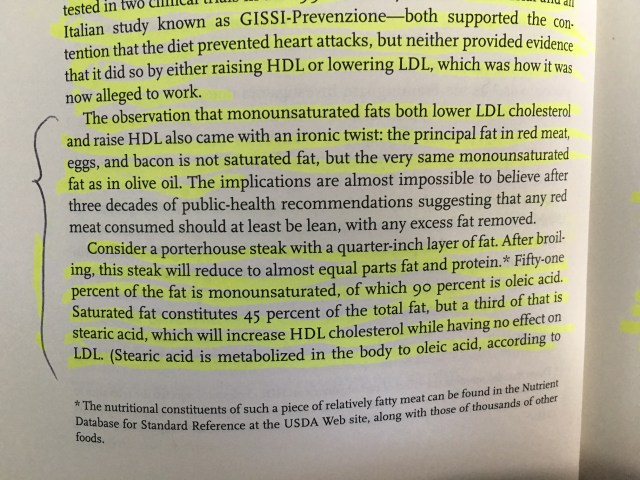
In reading Gary Taubes’ book “Good Calories, Bad Calories; Fats, Carbs, and The Controversial Science of Diet and Health” I found this section in the book very interesting and worthy to investigate:

Fat wars

Fat wars

I looked up in the USDA database the full nutrition information in order to compare the following fats:

Total saturated fat (a.k.a bad fat), Monounsaturated fat (a.k.a. good fat) and polyunsaturated fat (a.k.a. really bad fat) in the following food items: (100 gr = 3.5 oz) 100 gr porterhouse steak cooked, 1/8 inch fat; 100 gr avocado; 100 gr wild caught coho salmon cooked; 1 tablespoon olive oil.

Findings:

Fat Type                       Amount

Porterhouse Steak

total saturated fat             4.026
Monounsaturated             4.516
Polyunsaturated                0.513

Avocado
total saturated fat:            2.125
Monounsaturated             9.799
Polyunsaturated                1.816

Coho salmon
total saturated fat:            1.595
Monounsaturated             2.702
Polyunsaturated                2.521

1 tablespoon olive oil
total saturated fat:           1.864
Monounsaturated            9.850
Polyunsaturated               1.421

Note that a tablespoon olive oil has more polyunsaturated fat (the really bad one) than a 100 gr porterhouse steak!

So what do you think I will be eating? Steak of course! Dumping my olive oil! I recommend you reconsider what food you enjoy!

Comments, as always, are welcome.

Angela

Posted in Healthcare, Interesting reading, Must Read, This & That, Thoughts | Tagged , , , , , , , , , , , | Leave a comment

Why We Are Fat

NEWS RELEASE

A couple of days ago one of my articles:

The Misguided Battle Against Dietary Fat and Cholesterol

was published, which has created quite a stir on Facebook in some groups. I highly recommend you read it. The subject is very controversial:

Good fats versus bad fats & cholesterol: is it good or bad?

This article explains how we had been misled for over 80 years about the health benefits of saturated animal fats (yes, political interests but I do not get involved in that). I show you as well as possible in as simple words as I can what the problem is, why what we are told is not true and how you can change your life by simply dumping all your vegetable oils and statins.

Enjoy the read and comments are welcome, as always!

Angela

Posted in Big Pharma, Healthcare, Interesting reading, Press Release | Tagged , , , , , , , , | Leave a comment