
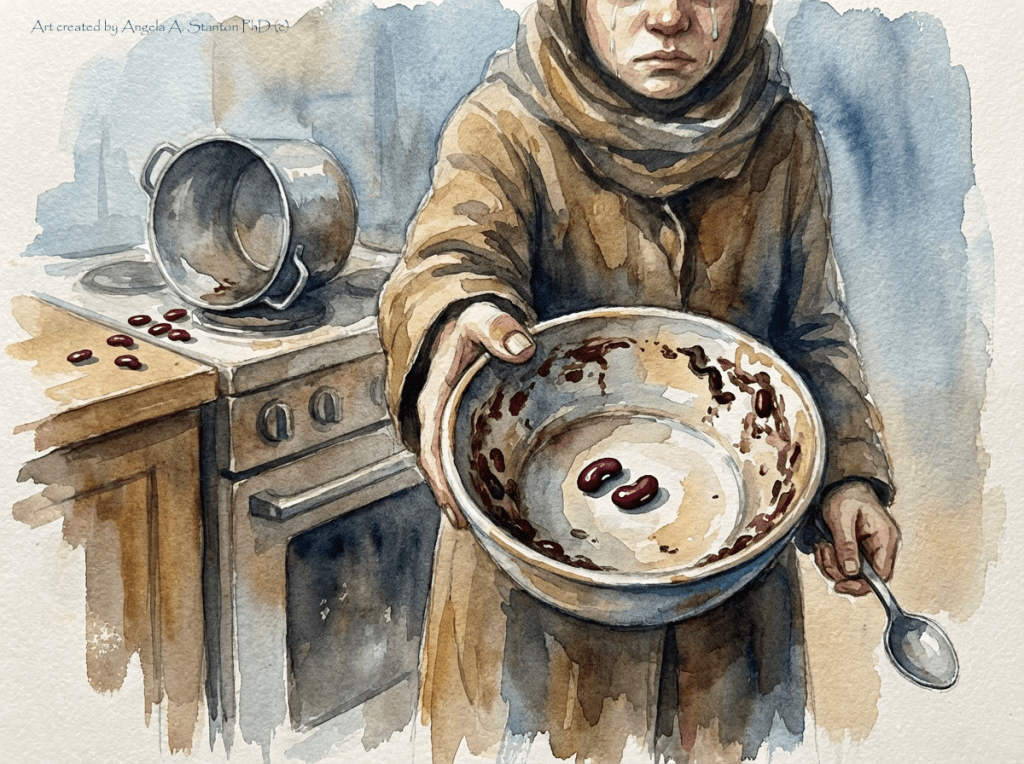
Art created by and is the property of Angela A Stanton, PhD (c)
The new DGA (Dietary Guidelines for Americans) was released a few days ago. Everyone is talking about beans these days! People want to eat beans! Why do they, might you ask? Because of the many years of misinformation campaign! And because the new DGA reduced the amount recommended.
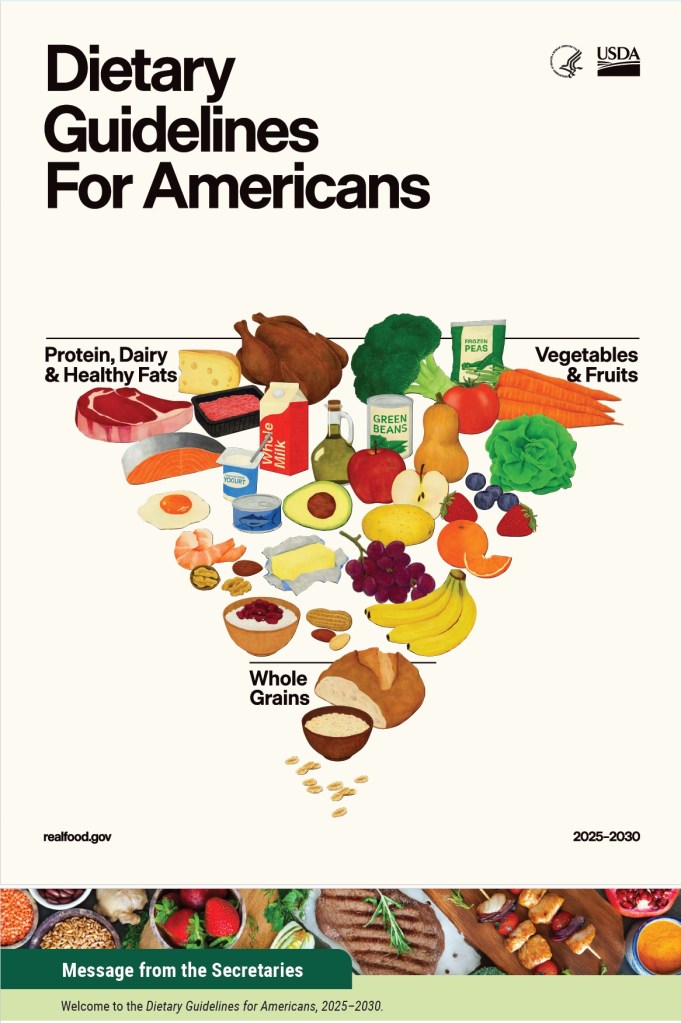
2025-2030 DGA
The up-side-down pyramid is a visual meltdown.. literally… I think my 11-year old granddaughter can draw something better in 5 minutes with closed eyes. As important as it is to have a visual appeal for something that is to last, trusted, and believed in for 5 years, that’s how unappealing this looks.
I understand the reasoning: it is literally the 1980 pyramid turned up-side-down. I get that… But did they have to apply an emoji-filled pyramid? Seriously? Look at the art you can create in less than 30 seconds using AI… Here is the second version of the lead image, aligning with the title of this blog, and I get 2 per instructions in less than 30 seconds:
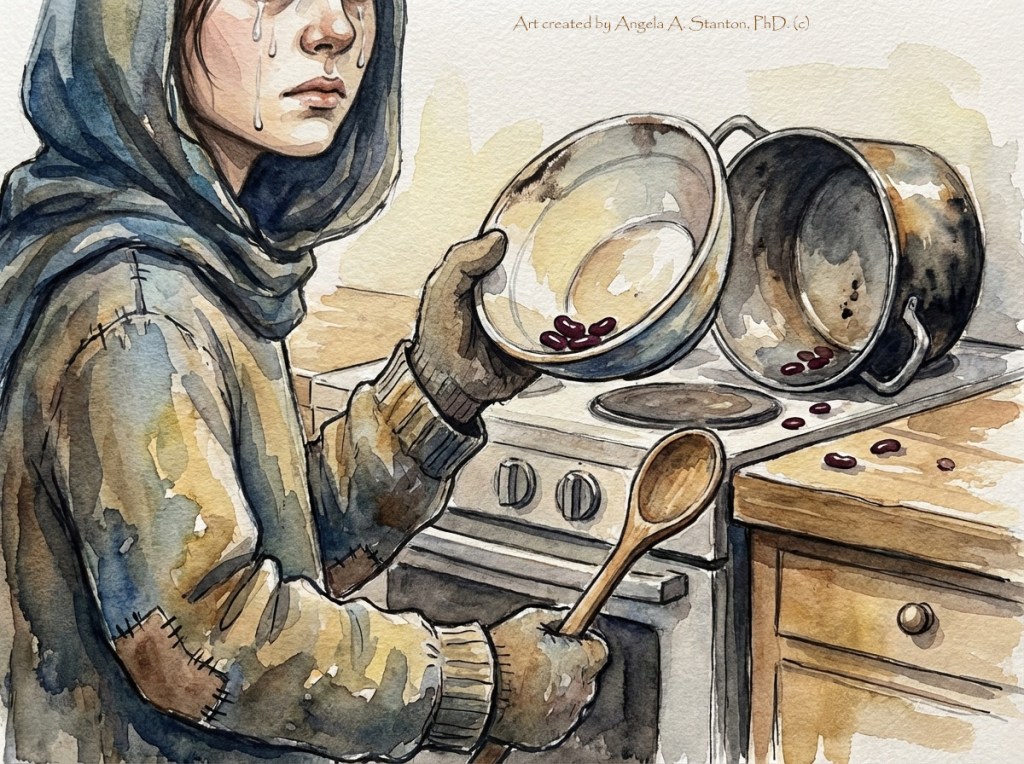
Art created by and is the property of Angela A Stanton, PhD (c)
As you can see from the cover of the new DGA, the focus is no longer on grains and starches, alas there is some allowance still on the menu, but nothing like it used to be in the previous dietary guidelines since 1980.
Many people are crying that beans and other legumes (starches) are reduced in the new DGA. They that beans are nutritious and provide essential nutrients. When asked what those nutrients are, I read comments like this:
“The articles I state come from the best scientists in the world…I’m talking Oxford University, The Lancet, Harvard University, the AHA, The American Diabetes Association, The Academy of Dietetics and Nutrition, the British Dietetic Association, and so on.” (These organizations are the most corrupt in terms of whom they accept funds from.. such as seed oil, processed foods, pharmaceuticals… see my experience with Harvard University here) and when they say that “but our research is independent from the funding”.. I say “right…”
“You’re denying reality. If you can’t see that there are societies thriving into old age by eating plenty of legumes for centuries now.”… but when I ask “where”.. there is either silence or the Mediterranean is brought up. But as someone having spent time in the Mediterranean (between 1950s and 60s as a child), I can tell you I have not ever seen beans served in the Mediterranean. In fact, not much vegetables were consumed there either. I wrote about the Mediterranean Diet here.
“Science proves that all plants have all amino acids, while yes, some have minimal amounts of certain essential acids, but luckily our body is amazing and pools aminos and completes chains when it gets all the aminos, no need to eat a complete protein in meals.” lol no.. this is not how our body works.. there are no bus stops with bench to sit and wait on for the amino acids until the rest of them arrive…
“I’ll kickstart your research by mentioning just 2 complete plants other than soy. Hemp and quinoa.” White technically correct, having trace amounts doesn’t mean it works…It’s not “any” tiny amount that is needed but the right amount to start muscle protein synthesis.
Or one of my favorite comments “eat everything in moderation“… ummmmmm right….
and the best: “The scientific consensus is overwhelming and very clear: Legumes are a superfood.” lol
What People Don’t Know Can (and Will) Harm Them:
Most people don’t seem to know or realize that while many plants have all amino acids, having them in trace or small amounts is nearly equal to not having them at all.
Muscle protein synthesis cannot happen unless sufficient amount of each essential amino acid is present in the food within a short time in one meal. The only plant with sufficient amino acids in all essential amino acids, is soy, but eating a lot of soy comes with dangers: trypsin inhibitors, phytates, lectins, saponins, tannins, and oxalates. These are some serious anti-nutrients! Granted, some of these are eliminated by cooking, but not all. The ones that cannot be eliminated are: phytic acid (phytate) and saponins, which bind minerals, thereby reducing their absorption, oligosaccharides (like raffinose and stachyose) also survive cooking and cause digestive issues, and oxalates. Not all tannins can be destroyed by cooking either. Tannins also bind to proteins and to minerals, hindering their absorption. And oxalates are the substance from which kidney stones are made–they bind to calcium in your blood and block off kidney function.
It is also suggested that beans (and other plants) reduce cholesterol. It is believed that cholesterol is made from fat, and so the argument is that if you eat beans and reduce fat, your cholesterol will be lower. But this is incorrect. Cholesterol is synthesized endogenously from acetyl-CoA, which can be derived from carbohydrates, fats, and proteins — and synthesis continues even during fasting. So even when we don’t eat anything, our body is still making cholesterol. Had this been understood 60 years ago, we wouldn’t be where we are today with obesity and type 2 diabetes. We got here because we reduced our dietary fat and so something else must have increased to get in as much food as we needed for our energy. So we increased carbs to an extremely high level.
Carbohydrates have some nasty properties:
1. Carbohydrates are addictive, like than cocaine or heroin
2. Grains release a morphine-like substance–this makes them extremely addictive and hard to quit.
3. The more carbohydrates we eat, the more insulin we release and the hungrier we get
4. Insulin resistance turns into type 2 diabetes
I wrote about all this 10 years ago, in 2016.
A little history, if you are interested in more details:
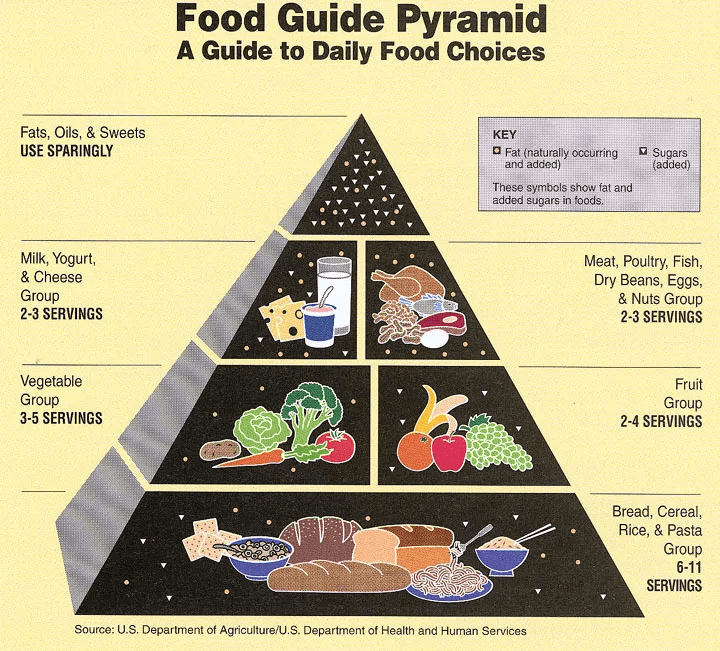
The 1980 Food Pyramid, the first DGA from here.
You cannot possibly believe how much grain and starches Americans had to squeeze down their throats daily during the 1980 DGA! Who eats 6-11 servings of bread, grains, and starches a day? And that’s just the grains and starches–we haven’t even started eating real foods yet! A relevant question: are we surprised why such a large percent of Americans have metabolic disease and obesity? Grains and starches are full of sugar but aren’t sweet, so you don’t even know you are eating sugar.
Many people tell me “but the fiber!” yes.. read bout fiber here. But the much antioxidants! Yep… read about the antioxidants here.
What exactly is a serving of grains or starches?
I am glad you asked.
A serving of grains, such as cereal or bread or pasta, and a serving of starches like beans, quinoa, rice, while vary greatly in weight, is usually as follows: 1 cup, about 40 gr in dry cereal, half a cup or 75 gr in cooked rice, while in cooked beans and legumes it is half a cup, which is about 100 gr. In cooked quinoa it is up to 1 cup, which is 185 gr. So let’s look at what’s in these in carbohydrates, proteins, and fats.
| Food (Typical DGA Serving) | Serving Size (cooked unless noted) | Net Carbs (g) | Protein (g) | Fat (g) |
|---|---|---|---|---|
| Dry cereal / bread / pasta (grain) | ~40 g dry | ~30 g | ~4 g | ~1 g |
| White rice | ½ cup cooked (~75 g) | ~20 g | ~2 g | ~0.2 g |
| Cooked beans / legumes | ½ cup cooked (~100 g) | ~20 g | ~7–8 g | ~0.5 g |
| Cooked quinoa | 1 cup cooked (~185 g) | ~34 g | ~8 g | ~3.5 g |
4 gr net carbohydrate is 1 teaspoon sugar equivalent. You can see in the table above that the least sugar is in a serving on white rice and cooked beans/legumes at 5 teaspoons of sugar per serving, whereas cereals are 7.5 teaspoons of sugar, and quinoa is 8.5 teaspoons of sugar. So might as well just eat the sugar…
Now let’s create a day’s worth of grains and starches based on the 1980 DGA: 6-11 servings a day:
Breakfast: a serving of cereal and a serving of bread,
Morning snack: a serving of starch,
Lunch: a serving of bread, 2 servings of starch snack:
Afternoon snack: pasta ,
Dinner: a serving of pasta, 2 servings of bread, and a serving of starch This is full 11 servings of the bottom shelf on the 1980 DGA.
Here is what you would be eating based on the 1980 DGA just from the bottom shelf and no real food yet, so starches and grains:
Just Starches for a Day
A) If ½ cup cooked rice (~75 g)
- Net carbs: 290 g
- Protein: 36 g
- Fat: 7.8 g
- Calories (from macros): ~1,374 kcal
B) If ½ cup cooked beans (~100 g)
- Net carbs: 288 g
- Protein: 58 g
- Fat: 9 g
- Calories (from macros): ~1,465 kcal
C) If 1 cup cooked quinoa (~185 g)
- Net carbs: 346 g
- Protein: 60 g
- Fat: 21 g
- Calories (from macros): ~1,813 kcal
Would you eat this much in starches and grains for your day? I know I wouldn’t ever do that again!
Comments are welcome, as always, and are moderated for appropriateness.
Angela


 Clueless Doctors & Scientists
Pingback: Junk Protein Craze! | Clueless Doctors & Scientists