
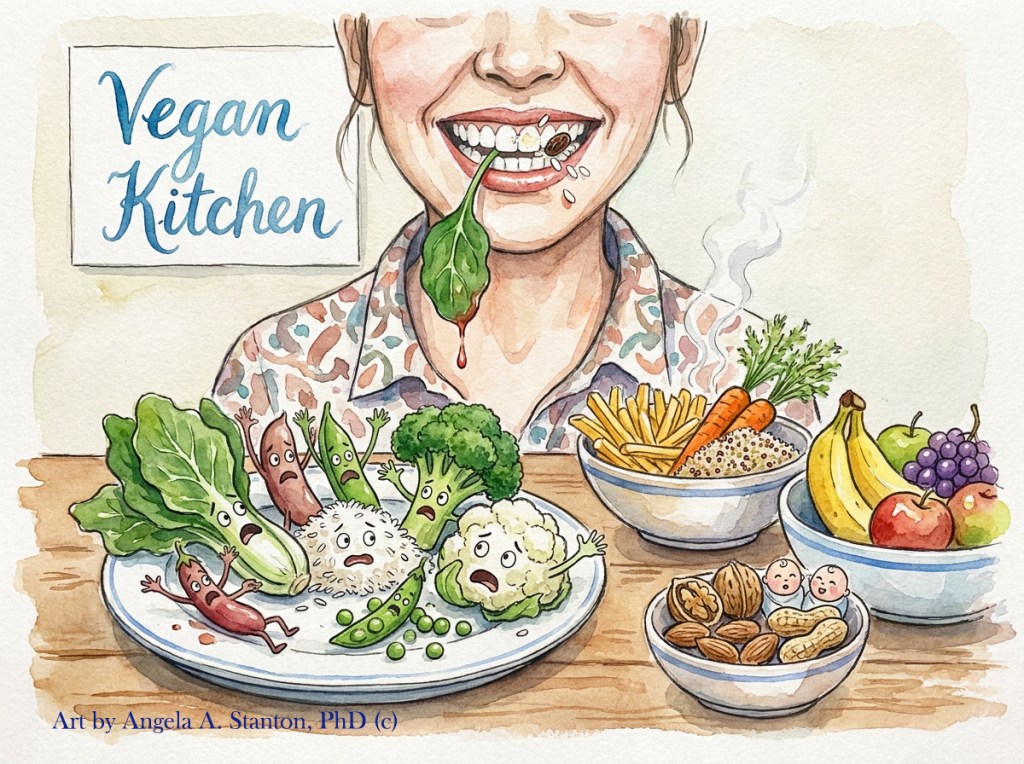
Since the agricultural revolution, humans have converted roughly 4.8 billion hectares — nearly 12 billion acres — of land into agriculture, land that once belonged to wild ecosystems and free-roaming animals. About one-third is cropland and two-thirds is pasture/meadow, showing that cultivation and managed food production together displaced enormous wild habitat (see here). About half of the world’s habitable land is used for crop growing (see here).
And while we are told that most of this stolen land is growing crops for the animals, we must keep in mind that these animals lived on the land without the need for cultivating, fertilizing, spraying against weeds and pests, and without water. They were able to feed themselves without our help! The only reason these animals are now on feedlots is because we took their land.
Surely, no one believes that we took the land and worked hard back-breaking work for years on the fields, just to feed the animals that were on that same land without anyone needing to work to feed them?! The idea is ridiculous.
In this post I am sharing a discussion I had with a vegan on LinkedIn. I use only their initial SA for the blog, but if you have LinkedIn membership, you can see this conversation here.
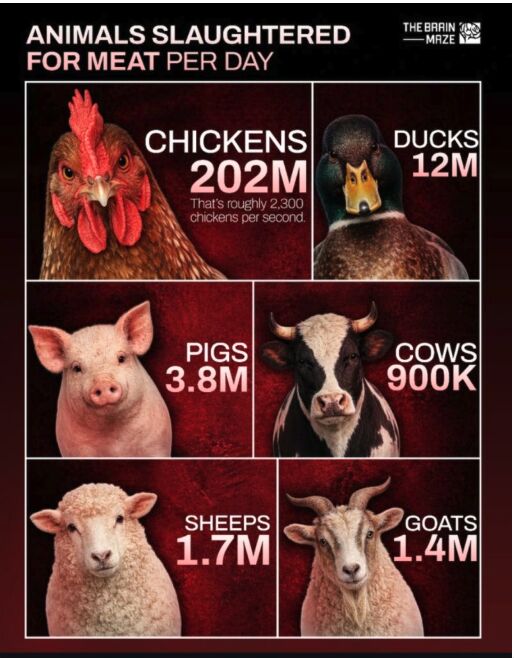
Below you will find SA’s original post “as is” on LinkedIn, I copy-pasted together with the picture, which SA likely created by AI. So the credit for this picture with the animals goes to SA.
Original post by SA:
“So, so, so much blood in the hands of human! An insane species!”
In what follows, I share the entire conversation, which is open for all to see on LinkedIn, and then I discuss it in detail:
Angela A. Stanton PhD : Such misinformation SA!! All creatures on this planet are alive, including plants. Less than 100 years ago humans believed that dogs didn’t feel pain. Don’t let your ignorance let you believe that plants feel no pain! They do because they are alive and they do everything in their power to stay alive, including the healing of wounds.
SA: That’s information, with no meaning or synthesis. Just opinions! Poor comment. Everything has feelings of course, but everything has a principle. Plants produce grains, fruits etc. as a waste. That’s a universal process. It needs to be ejected out. Like a mother with a baby inside, the principle is it is a waste of the Universe and has to be ejected out. That’s the principle… universally. if one doesn’t, it rots, it poisons the whole. That’s the cycle of the Universe. Read Gurdjieff, check empirical evidence. If humans think dogs don’t feel pain – that’s their own utter recklessness to justify misdeeds on animals for their own propagation of profit. Don’t you see how the human species is the biggest predator of all. it even kills its own species. They prey on the weak and the innocent. Going back to your comment – yes, there is pain everywhere. Humans have no principles and no alignment with the cosmos. Why won’t they have pain?
Angela A. Stanton PhD: the human species is the biggest predator of all. That’s why you live in a house or apartment and have no fear of a tiger or lion eating you. If you accept that you are a human and are, therefore, on the top of the food chain, then you have no choice but kill to eat. That is how you evolved and that is the reason why you are human and on this planet.
Humans do have pain. I bet if you broke your arm, you would feel pain. But I also bet that if you ended up on an uninhibited island full of animals with zero plants, you would eat an animal.
So please… save those nonsense comments on the principle of waste. Total nonsense. I am a modern scientist who is well versed in astronomy and physics. Humans, plants, animals, mountains, etc., are all made up of the exact same elements. There is no waste. It’s all about the smallest particles of the universe. We all are made from those. The rest is just a mirage and temporary.
Humans sure made up a lot of nonsense as they tried to explain life. But one can either be sentimental about it or just live. I chose to live.
SA: Please – no flashy statements like astronomy/physics, modern scientist etc. I deal with these subjects daily and have built an exceptional Cybernetics AI, and i can teach these stuff to PhD’s. Stay on topic please. Scientists can study etc- but what defines oneself is not intellect. Ethics, compassion, kindness – these are elements that define being human. Just like you choose to live, others like animals do too. Just plain intellectual speak abstracting suffering of sentient species saying ” I choose to live?”, come on … is life a Zero sum game? Just because one chooses to live doesn’t mean they have a life. A life is well lived where compassion exists. And if you have felt pain, why create pain for others. When philosophy is wrong, nothing else matters. Also note: Most people never see a lion or tiger in their entire life, and don’t build homes for that kind of protection. People build homes to find their safety from the rest of the humans. Also to shade themselves from mosquitoes 🙂
Angela A. Stanton PhD: life is not a zero-sum game based on what humans call value. But absent a society, a human on an uninhabited island who never sees another human, is a zero sum. In other words, the knowledge we pass on to each other makes it more than zero sum. It only has value for humans, not to life, in general! “People build homes to find their safety from the rest of the humans.” This sentence implies zero sum. So decide which version you prefer to believe in or preach!!!
But what you think makes little difference to life as a whole. Humans are the top predators because they can eat any animal they wish.
This also shows another important thing:
No herbivore has EVER become the top in the food chain! So why would humans ever be considered to be herbivores?
They clearly aren’t. What you preach even you get confused about. At least I am honest. I am a human. I eat animals. I am a top predator.
SA: I appreciate your honesty. I do. Your stance is clear. I just wish, it had more compassion and feelings while standing at the top of the food chain on those who do no harm to you. When the Mind is in control, the Heart goes feeble.
Angela A. Stanton PhD: the heart is not feeble; the heart must survive too. While in imagination it represents many things, in reality it is a pump and has an important role in my life to manage human survival. If your heart doesn’t get nourishment, it too dies.
I understand your sentimental view of life. Many people view life through similar glasses.
But when two humans compete for life resources, the heart changes into survival mode. If you were left on an uninhibited island and had zero options other than eating animals (no plants, just soil), you too would be eating animals. All sentiments would disappear and survival would overtake.
You can only remain “ethical” and vegan while the plant option exists.
—
The end of the LinkedIn conversation. Let’s discuss this further.
UPDATE: I am adding a YouTube video here. After a week past the release of this article on Facebook, X, and LinkedIn, and the HUGE vegan attach on my article on Facebook, it is clear that an educational video on the smarts and lives of plants should open up the discussion. Vegans believe that plants are free to forage because they are not sentient, can’t feel pain, and if they eat only plants, they save the animals. None of these is true, of course. Enjoy this video:
Watch this video to learn how smart plants are, how they communicate, smell, and listen. They are definitely sentient beings.
The Vegan Excuse – The Basis for Veganism: Plants are not Sentient
The word sentient is defined as follows: “Sentience is the capacity to have subjective, conscious experiences, primarily the ability to feel sensations like pleasure, pain, and emotions”. Note how narrow it is in its definition. It was as late as 1980 that humans first accepted that dogs feel pain! Can you imagine that?
“For a long time, particularly in academic and scientific circles, animals were considered to lack consciousness or feelings in the way humans do, a view traceable to 17th-century philosopher René Descartes” (see here).
And while animals may lack many things that “humans” do or have, can we assume that this means they don’t have any sensation of pleasure, sadness, or pain? Seriously? It is an extremely narrow “human-centric” view with which we can easily exclude anything and everything—including your neighbor who makes too much noise or doesn’t trim their lawn.
This is “the” point based on which vegans suggest that it’s OK to eat plants. Plants are not sentient; they feel no pain. Some misinformed vegans even claim only animals are “alive”, though the majority understand and accept that plants are alive. Some vegans refuse to accept that they kill the plant by eating it, and others suggests that it’s OK to kill them because plants don’t feel pain.
I beg to differ on all counts.
We know that plants heal their wounds, respond to heat/cold, moisture/draught, light/dark, and also there are some studies showing that plants can plan and attach animals that overgraze them.
Are Plants Sentient?
It depends on your definition of what sentience means. To me, if a “thing” turns toward the sun, needs to sleep, repairs or seals off damaged areas in its body, have organs, those organs work similarly to those organs of animals, and if that thing can respond to danger by making immediate changes for self-preservation (not to mention warning other plants of the danger as well), then that “thing” is not only alive but is capable of feeling pain and have sentience.
Do plants meet all these?
For those of you prefer videos instead of reading: I have collected a YouTube archive in which scientists are presenting their research on plant sentience (see here).
I use the academic AI Consensus to find academic articles of interest. I wrote the following: “Plants have a nervous system”. And I pressed “go”. It found many articles of interest that discuss the very topic. Here are the summaries of articles that support the statement:
- Plants generate action potentials and other electrical signals that propagate through cells, tissues, and along the vasculature, including phloem (see here, here, here, here, here, and here)
- These signals are slower and longer-lasting than animal nerve impulses (seconds to tens of seconds; millimeters per second) and involve different ion channel mechanisms (see here, and here).
- Electrical signals link local stress (wounding, herbivory, temperature, water status) to rapid systemic changes in gene expression, hormones, photosynthesis, transpiration, and defense (see here, here, here, here, here, and here).
- Plants can feel danger and make immediate changes in response to defend themselves (see here).
Chemical, hormonal, and calcium networks:
- Plants use phytohormones (e.g., ABA, jasmonates, salicylic acid, ethylene) in complex, interacting networks to coordinate development and stress responses across the whole plant (see here, here, here, here, and here).
- Long-distance mobile molecules (hormones, peptides, RNAs, metabolites) travel through the vasculature to mediate organ-to-organ communication (here, here, and here).
- Transient calcium waves and Ca²⁺-decoding networks (such as the CBL–CIPK system) translate stimuli into specific responses and integrate growth with stress adaptation (here, here, and here).
Memory and behavior without nerves:
- Plants show stress memory and priming, storing information about past stress via epigenetic, transcriptional, and metabolic mechanisms, despite lacking a nervous system (see here).
- Studies describe flexible plant “behavior” (movement, decision-like responses, attention-like phenomena) organized by distributed sensory and signaling systems rather than neurons (see here).
So while plants do not have a nervous system or brain like animals/humans do, plants rely on distributed electrical, hormonal, and molecular signaling networks to sense their environment, communicate across tissues, remember past stresses, and coordinate complex behaviors. In other words: plants have hormones that direct their body functions just like in humans. And these hormones communicate between tissues. Plants have memory, recognize siblings, and can destroy enemy plants.
Plants Have Memory:
Plants cannot think like animals, but research shows they can store information about past conditions and use it later. This “memory” changes how they react to repeated stresses such as drought, heat, cold, salt, or attack by pests and diseases, and in some cases can even affect the memory of their offspring.
Somatic vs. heritable memory: Some memories last within one plant’s lifetime (somatic), while others leave epigenetic marks that influence the next or later generations (inter‑ and transgenerational memory) (see here, here, and here).
Plants have a circadian rhythm, just like animals, which is independent from light—in other words, if the plant is placed under unchanging light 24/7, it will have a sleep time—just like animals do—independent of external light (see here, here, and here).
And I can go on and on, finding fascinating things about plants and how much they are very much aware of their environment and definitely feel when they are eaten!
In summary: plants are very much feeling and sensing sensitive organism, which are different from animals but in no way do they give their lives willingly to be eaten. In fact, plants have created an army of weapons to keep you from eating them. These are anti-nutrients!
The following lists are copy-pasted from Google search with citation links:
Top Human Illnesses & Conditions Caused by Antinutrients
- Kidney Stones (Calcium Oxalate): Caused by oxalates (in spinach, rhubarb, nuts) binding to calcium in the kidneys.
- Goiter and Thyroid Dysfunction: Caused by goitrogens (in broccoli, kale, soy) inhibiting iodine absorption, leading to thyroid enlargement (goiter) or hypothyroidism.
- Food Poisoning / Severe Gut Distress: Caused by lectins (in raw/undercooked beans) causing severe nausea, vomiting, and diarrhea (phytohemagglutinin toxicity).
- Mineral Deficiencies (Iron/Zinc/Calcium): Caused by phytates (in grains, seeds, legumes) chelating minerals, leading to deficiency, especially in restricted diets.
- “Leaky Gut” and Inflammation: Caused by lectins and saponins (in legumes, quinoa) binding to and damaging the intestinal epithelial lining.
- Anemia: Caused by tannins (in tea, coffee, wine) binding to iron and preventing its absorption.
Detailed List of Illnesses by Antinutrient Type
(The following is copy-pasted from Google)
1. Lectins (e.g., Phytohemagglutinin, WGA)
- Sources: Raw legumes (kidney beans), whole grains, nightshades.
- Illnesses/Effects: Food poisoning, diarrhea, nausea, vomiting, increased intestinal permeability (“leaky gut”), intestinal hyperplasia (growth).
- Autoimmunity: Potentially triggers or worsens autoimmune diseases by activating the immune system through gut lining damage.
2. Oxalates (Oxalic Acid)
- Sources: Spinach, chard, rhubarb, beets, almonds, chocolate.
- Illnesses/Effects: Calcium oxalate kidney stones (75% of all kidney stones), chronic kidney disease (if excessive), vulvar pain, joint pain/stiffness.
- Sensitivity: Burning in eyes, ears, mouth, and throat.
3. Goitrogens (Glucosinolates)
- Sources: Broccoli, Brussels sprouts, kale, cabbage, soy, millet.
- Illnesses/Effects: Goiter (swollen thyroid), hypothyroidism, iodine deficiency symptoms, increased risk of thyroid cancer (specifically in those with low iodine intake).
4. Phytates (Phytic Acid)
- Sources: Whole grains, legumes, seeds, nuts.
- Illnesses/Effects: Zinc deficiency, iron-deficiency anemia, calcium deficiency (bone loss).
5. Saponins
- Sources: Legumes, green lentils, quinoa.
- Illnesses/Effects: Gut inflammation, membrane disruption (leaky gut), hemolytic reactions (breakdown of red blood cells) in extreme cases.
6. Tannins
- Sources: Tea, coffee, wine, berries.
- Illnesses/Effects: Severe reduced bioavailability of iron and protein, reduced weight gain/feed efficiency (in animals).
7. Solanine / Protease Inhibitors
- Sources: Nightshades (potatoes, eggplant, tomatoes).
- Illnesses/Effects: Inflammatory bowel disease (IBD) flare-ups, joint pain/arthritis, nausea, headaches.
Plants are fighting back! They don’t want to be eaten! They are very much alive and feel when you eat them!
How the Earth Sees Vegans
In order to be vegan, a person needs to eat much more food that a typical human has to eat. A 70-kg (~142 lbs) adult’s official protein RDA is 56 g/day, but that assumes digestible protein. Plant proteins are less digestible and have incomplete essential amino acids. Protein quality depends on digestibility and essential amino acid pattern, not just grams on a label. So a vegan needs to eat roughly 1.2–1.6 times more plant protein to deliver the same usable amino acid value as animal protein (see here).
A simple comparison:
For about 70–80 g high-quality protein plus 100 g fat—note since only protein and fat are essential nutrients, I only use protein and fat to assess the nutrient value of what carnivores and vegans must eat:
A carnivore could get this from roughly 400–500 g fatty beef/eggs. That food contains no fiber, very little indigestible residue, highly bioavailable protein, highly available fat, B12, heme iron, zinc, retinol, choline, carnitine, creatine, taurine, etc.
A vegan would need approximately 700–1,200 g of tofu/beans/lentils/nuts/seeds/oils to reach similar protein and fat numbers, and even then the protein quality is lower (lack of sufficient essential amino acids) unless carefully combined and eaten in larger amounts. The fat usually has to come from concentrated oils, nuts, seeds, avocado, or coconut, because legumes and grains are not fat foods. This means that the vegan plate becomes large, bulky, carbs and fiber-heavy. Carbohydrates are not an essential nutrient so are not considered here for equality calculations.
Vegan vs Carnivore Waste
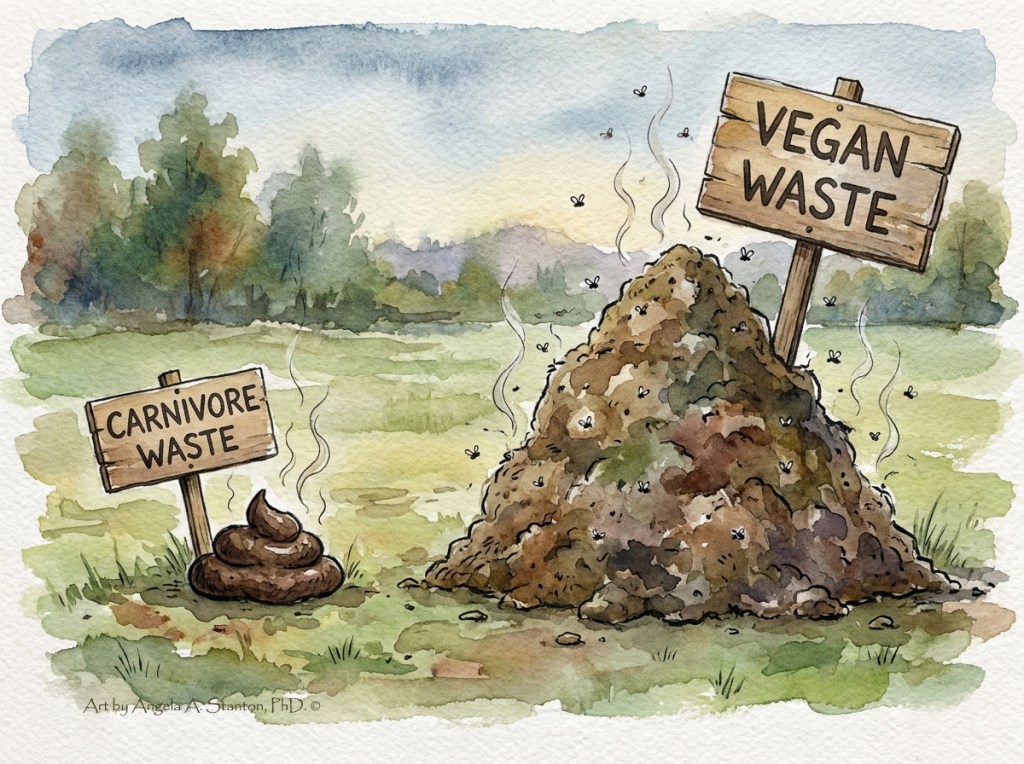
The feces point is very important because we are already flooded with waste products. The human feces is considered to be a biohazard and is usually not used as fertilizer. It is important to compare the feces amount generated in the two eating styles. It is also an important consideration for global warming, but is never ever included! It should be!
Fiber is indigestible plant matter. A systematic review found intact wheat fiber increased stool weight by about 3.7 g for every 1 g of fiber consumed. Another review found each additional gram of fiber increased total fecal weight by about 1.76 g/day and dry fecal weight by 0.47 g/day. So a vegan eating 40–70 g fiber/day can plausibly create 70–250+ g/day more stool mass than a low-fiber animal-food diet, depending on fiber type and water binding (see here).
The crop-input point is also important. Modern plant agriculture is not “natural”; it is chemical and mechanical. FAO (Food and Agriculture Organization) reports global agricultural use of inorganic fertilizers reached 190 million tons in 2023. FAO also reports pesticide use in agriculture at 3.73 million tons of active ingredients in 2023, with pesticide use per cropland hectare doubling since 1990 (see here).
The land claim needs nuance. FAO says current agriculture uses about 4.8 billion hectares, with about 1.6 billion ha cropland and 3.2 billion ha permanent meadows/pastures. Vegan food comes almost entirely from cropland, which is the land most directly cleared, plowed, fertilized, sprayed, irrigated, harvested, and stripped of wildlife habitat. Ruminants, by contrast, can convert non-arable pasture, cellulose, crop residues, and byproducts into human food (see here) without anything added.
Vegans wake up! You aren’t “saving animals”.
Animals were removed from their land and shoved into feedlots!
It is because of vegans that all that land was repurposed to crop growing instead of feeding the animals that were naturally there!
Vegans kill millions of insects (including bees) each year. All the birds that used to feed on insects are dying of hunger. All the insects, and the very important ground worms are gone as a result of crop growing.
If You Are a Vegan: Man up! Accept that animals and plants are killed by your eating habits. And that’s OK. You are a top predator (alas eating the food of herbivores)! Stand up for who you are: you kill to eat and live! You are just another human trying to survive! Don’t lie! And don’t be fooled! You are causing more harm and damage to the environment than those of us eating mostly animal products—read about that here.
Your comments are welcome, as always, and are censored for appropriateness.
Angela


Angela, I just now read “The Vegan Lie” and am interested in learning more about how to increase my “healthspan”. For years now I have been eating a mostly whole-food plant-based diet with occasional fish and chicken. Much of my nutritional choices have been informed by the research results cited by Dr. Fuhrman and by Dr. Greger (in https://nutritionfacts.org), which means I eat a lot greens, beans, nuts & seeds, and assorted vegetables and fruits. Can you point me to peer-reviewed journal articles that show how I can achieve better health with fewer diseases of aging by modifying my diet? (Like you, I live in Southern California.)
LikeLike
Hi Daniel,
Glad to chat with a fellow SoCal person.
There are several points I need to make to your request:
1. Greger and Fuhrman:
2. Eating chicken and fish with a plant-based diet
3. Peer review and its importance
4. Just think…
1. Dr. Greger: a few points of interest.
a. I searched the database of all publications and he doesn’t have a single research article in nutrition. Here are all the publications with his name attached.
b. He could be my son but looks old enough to be my brother (I am in my 70s)… This is important! And I don’t mean this in a negative way but he is very frail.
1. Dr. Joel Fuhrman: a few points of interest:
a. Here are all the publications his name appears in.
Summary on the 2 doctors: not one of their papers is a research paper, alas I am sure the papers published are peer reviewed–they always are. Fuhrman has a couple of studies on nutrition but he compares the SAD to plant-based and that’s an obvious benefit. Comparing eating dirt to the SAD diet will give better results.
2. You are eating chicken and fish time to time, so likely your diet is more or less fine–keep check of your vitamins and minerals in your food. The 100% vegan diet is nutritionally severely deficient.
3. Peer review and its importance: As noted, all papers published in academic journals, good or bad, are peer reviewed. As a peer reviewer myself, I can tell you how messed up that system is. In fact, a friend of mine who is a Nobel Laureate in Economics, has tested the peer review system by publishing a paper in several journals (with the knowledge of the trick by the journals). Sometimes he was the first author, sometimes his coauthor–a newbie in the field whose name was not known–was the first author, sometimes the authors were hidden, etc. He wrote an amazing paper based of this experiment. The important point here is that whose name appears first on the paper greatly matters! It is much more likely to be accepted if the first author is known, even if the paper is shitty.
This is why so often papers are pulled retroactively. A most recent story underlies this.
For the past 20 years, a single paper ruled whether women in peri-menopause, menopause, and post-menopause can get estrogen hormone replacement. That study showed that women are more likely to get cancer when given estrogen, and so no one could get estrogen therapy. I had to wave all my rights and sign my name away to make sure I am liable for my own decision of taking estrogen against my doctor’s advise. This paper held all women hostage to this absolutely faulty finding for 20 years.
Finally, in early 2026 this paper was officially revealed to be absolutely wrong, the research done wrong, and the statistics understood all wrong, and it was pulled! So now, all women can finally stop suffering and get their estrogen therapies. But how many women died as a result of broken bones leading to complications and death as a result of no estrogen that was wrongly held to based on this paper? How many heart attacks and strokes? How many countless nights spent sleeplessly in a pool of sweat? Suffering like a dog?
Yet, it was in a peer reviewed paper… and all completely wrong!
So what is the importance of a paper is peer reviewed? 0
4. Just think!
The planet is a resource with specific supplies. Humans (from the point where we can call this ape species “prehuman”), came down from the trees about 2 million years ago. During most of the passing time, they discovered how to tame and use fire, how to hunt, eat meat, marrow, fish, etc.
Starting 300,000 years ago the last ice age started and it lasted up until about 10-12,000 years ago, the time when humans started living in communities and growing some grains. But for 300,000 years, there was an ice age.
Humans living out of Africa already at that time lived north of the 35th latitude–we find the caves and bones with tools, so we have some knowledge of their history. Since there are no plants growing under snow and ice, and since most of what is now Europe and Asia were under snow and ice, there were not many plants to eat. Being a vegan 300,000 years ago most certainly ended in death.
The inability to survive on plants continues even after humans started farming because there were no cars, planes, trains, refrigeration, and hot houses in which people could grow veggies and fruits and deliver them all over the world. In fact, most veggies and fruits we eat today didn’t even exist until a few hundred years ago… Cruciferous veggies were created from the wild mustard plant about 500 years ago. There was no potatoes or similar in Europe or Africa until after Columbus.
You need to consider what was historically available for humans to eat, which is mostly animal products and fruits and veggies only seasonally locally. But even beans and rice have a starting point in human eating. Most old-world beans appeared about 3-5000 BCE, so ~7000 years ago, and rice around 400 BC. Quinoa was not a food until about 7000 years ago and only for the Incas. And you can search through the history of each plant to find out when humans started to eat them and how they arrived and where.
You will find that there was no such as a plant-based diet before 600 BCE (India). The whole idea of eating plant-based in Western culture comes from a few very strong interests: the Seventh-day Adventists whose religion depends on it, and the rest are all money-making institutions. Plant-eating has never ever been a “healthy” diet because plants weren’t around all the time to eat. It was a luxury to eat fruits and veggies in most of humanity.
During some human periods grains and legumes have become very easy to grow and ended up in surplus, and so these became the foods of slaves and the poor. They were never the main foods for those who could afford to eat better. It is unclear to me why so many humans prefer to eat slave food (literally) and are proud of it, believing that it is healthier and better for them. It is not. Only we haven’t had good medical records of comparisons because the entire SAD movement, which started in the 1960s by Ancel Keys, whose “hypothesis” has become a law without any evidence.
So no, we don’t yet have much peer reviewed academic publications on eating an animal-based diet primarily because the IRB (internal review board) won’t approve clinical trials and because journals refuse to publish. Why do journals refuse? For several reasons, here are two: 1. the titles that recommend the eating of meat are politically incorrect and will never make the news, and 2. because the advertisers that keep up the life of these academic journals are the food companies and big pharma. And one does not bite the hand that feeds it.
I recommend that you read this paper, which I wrote when I took a nutrition certificate class at Harvard University… Just see what they teach there.
This turned into a paper on its own.
Cheers,
Angela
LikeLike