
New FDA recall on 12-31-2014
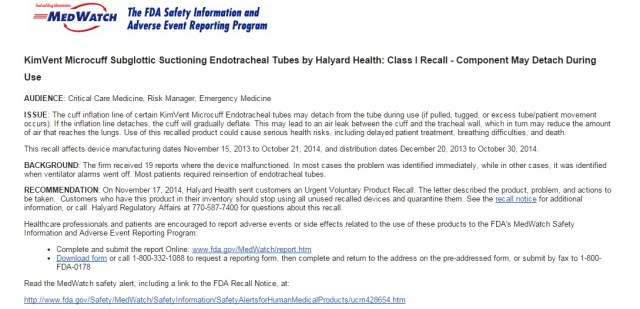
FDA recall 12-31-2014
Click on picture to get to the original FDA message!
Angela
New FDA recall on 12-31-2014
FDA recall 12-31-2014
Click on picture to get to the original FDA message!
Angela
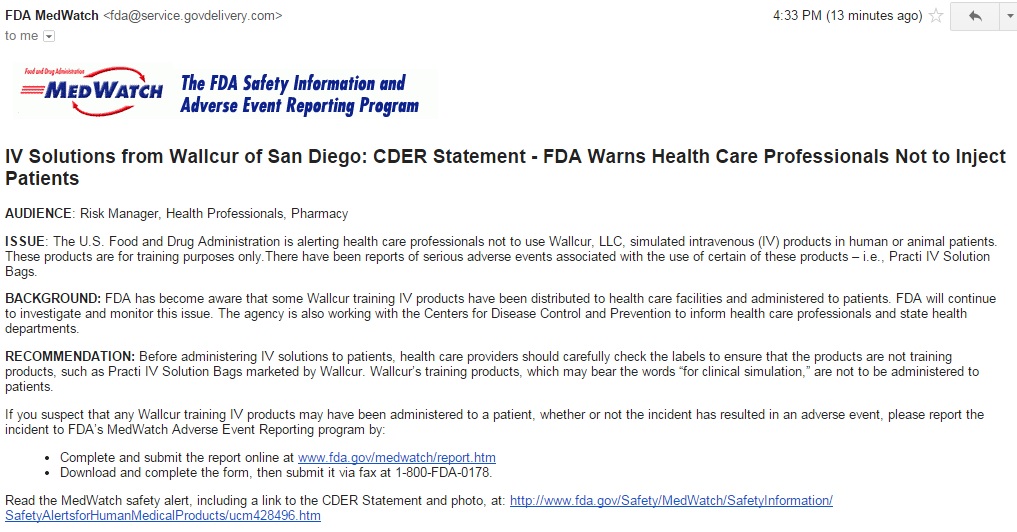
FDA warning 12-30-2014
From now on I will try to keep an updated information database here from emails I receive from the FDA on all new warnings of contamination or adverse effects that place a drug on hold or under a new black box label. The above is warning for today! It is relating to IV (intravenous) products provided typically in hospital settings. The FDA has recently found that many IV solutions were contaminated. I am starting my posts of warnings today but this is not the first time this year this IV contamination warning appeared.
To see all warnings as they come online, please visit this link for 2014. I will update the link for 2015 if it changes.
Indeed there is — as I too found out over the holidays this year. As most of you who read my blog and have read my book probably know I have had migraines for well over 20 years (30 years is more like it) before I realized what caused it. Since then I have been migraine free except for this holiday season. So what is different?
Let me recap the cause of migraine, which is preventable and treatable without any medicines. The details of how and what are in my book Fighting the Migraine Epidemic (shop around for prices if you buy it!) and in several articles at HormonesMatter but here I would like to give a little summary and some additional information about how sweets connect to pain in the head–any pain, be it headache or migraine.
Migraine is not necessarily pain. Migraine is a chemical chain of events that in about 80% of the time culminate in pain but there are silent migraines and many aura migraines that are not followed by pain. The events that lead to migraine are also chemical chain of events that start by ionic imbalance of the brain. In the body everything we eat breaks down into molecules and then ions so that our cells can have their meals. Cells “eat” by having openings (pores, channels, pumps, gates) on the cell membrane through which ions can pass. But an ion by definition has a polarity, meaning it is either positive (+) or negative (-) and if you have ever taken any physics or chemistry or just know about the magnetic poles of earth, you know that “++” or “- -” repel and “+ -” attract. Thus something in ionic form may only enter a cell if it has the right polarity for affinity (attraction), otherwise it is not permitted into the cell.
There are two key ions that initiate the electrical contraction of a cell by creating voltage. Voltage difference causes a contraction that opens some of these pumps, gates, pores, channels, etc., and allows nutrients to go in and toxins to come out in particular order and ion numbers. Two responsible ions for this electricity are the key to migraine. If there is not enough of these ions on both sides of the cell membrane for the creation of voltage, the cell cannot open and depolarization (areas without the capability to create voltage) appear. Depolarized regions in the brain prevent that part of the brain from functioning which after a chain of events creates migraine. The two elements of discussion are Na+ and Cl-, which combined form salt. Thus not enough salt will cause migraines.
There are basically two kinds of sweets: sugars (sucrose, fructose, glucose) and artificial sweeteners (any kinds other than sugar).
Lets talk about real sugar first. As you can see there are 3 main types. Glucose is the same as what is in our blood so it can be called blood sugar. Lactose, sugar in milk is a type of glucose. Sucrose is sugar the body can convert to glucose. It can be found in carbohydrate foods such as rice and potato, which many people avoid as “bad carbs” but are in fact way better than the last group: fructose. How bad fructose is for your body is probably news to you since fruits have tons of fructose in them and we are told that fruits are healthy and we are told to eat them. And so they are! Fructose when you eat it as a fruit with fiber is great. There is a long explanation via video and by book titled Fat Chance by Robert Lustig, M.D. of what fructose is and what it becomes. Few actually understand the seriousness of it so let me explain in as simple way as I can what fructose is and what it does so you can understand its bad effects on the body and on migraine.
Fructose is sugar in the fruit. If you eat a spoon of fructose (they sell fructose on its own, try it), your body will experience no change. You will not feel hot (as you would from glucose) and you will not bounce off the walls (as children do from glucose and sucrose) if you only eat fructose as powder, crystal, or liquid. The reason why not is because fructose is not seen by the body as sugar. It doesn’t make it to the brain or muscles as energy source! It goes straight into the liver, where it converts by a long chain of events into ethanol–the alcohol you put into your car to improve mileage. Eating fructose without fiber causes non-alcoholic fatty liver disease and causes obesity.
See when the body does not see sugar and insulin is not released to deposit sugar into fat that later can be converted to blood glucose for the use of the brain, a hormone called leptin tells the brain that there is obviously a famine so it slows all bodily functions to the minimum to save energy, reduces metabolism, and makes you hungry for sugar. So you eat more fructose. The more fructose you eat the more lethargic and obese you will also get and will have no energy to get off the sofa. This is Fat Chance book in a very short summary.
The connection of fructose to migraine is simpler: sugar, similarly to salt, attracts water and collects it. But unlike salt, it cannot enter any cell without creating voltage, which sugar does not do. Thus instead of hydrating cells, it dehydrates via osmotic gradient by pulling water out of the cells. Eating fructose dehydrates cells, interrupts the hydration process, thereby interrupting the very thing that prevents and stops migraines: ionic balance hydration. Fructose causes migraines or headaches that are hard to combat because fructose does not leave the body easily; it is chemically tied down to become other elements, such as ethanol. How it reaches the brain for its dehydration action? Via the circulatory system. Eating fructose removes water from blood circulation via osmotic gradient and since there is less volume of blood (same number of blood cells only each dehydrated), blood pressure increases from eating fructose. You can check all of these out at home using blood pressure meter, placing fructose near water and see how it sucks it up like it had lips, etc.
Less is discussed about artificial sweeteners in literature but logic prevails. By artificial sweeteners I also mean all “natural” sweeteners with zero calorie. Sugar, no matter how natural, with zero calorie is not sugar to the body. Artificial sweeteners do some really nasty stuff: they cause diabetes mellitus type II. How does that happen?
Artificial sweeteners–even zero calorie sweeteners–release insulin. The job of the insulin is to grab the sugar in the blood and convert it to fat for future use by the brain and muscles as sugar–as mentioned earlier. Insulin is in the blood in search of sugar but there is none!! Sugar was not consumed! So insulin floats in the blood for a long time in search of sugar. The constant insulin in the blood signals the body to ignore insulin and hence one develops what is called insulin resistance. This is greatly simplified here for understanding. Something floating in the blood looking for sugar and not finding any will eventually be ignored by the body. Insulin resistance is diabetes mellitus type II.
Should you ever eat or drink foods or drinks, respectively, that contain artificial sweeteners? Never.
How artificial sweeteners connect to migraines should be straight-forward based on what I wrote on fructose. Artificial sweeteners attract water exactly the same way as fructose does, thereby acting as diuretics in addition to causing diabetes mellitus type II.
So what did you have for your holiday sweets? Did you eat a bunch of sweets? Cranberry sauce with the turkey, pies with whatever sweets, candies hanging on the Christmas tree if you celebrate Christmas or elsewhere if you celebrate other holidays at the end of the year. Every time you eat sweets of any kind–other than fruit with the skin on, which heads straight to the gut to feed the good bacteria–your chances for a migraine are pretty good.
I normally don’t eat sweets of any kind but this time I was invited to a party full of sweets on every table; in fact there was more sugary stuff than food. Yes, I am human and could not resist. Yep, I did get a migraine and because it was caused by sugar, the treatment of salt did not work right away. Sugar had to reach a low enough concentration in my body to allow the hydration to return to normal. It took 2 days to do that. And to me this was proof that sugar in any form is trouble! And if you are a migraineur, it is double trouble!
Your comments are welcome as always!
Angela
When we salt our food, we rarely think of salt as a crucial aspect of our body in many ways. In particular we think it has absolutely nothing to do with anything other than taste and we certainly do not think of hormones. In this short post I would like to enlighten and clarify a few myths about salt and salt types and also hint at their importance and hormonal connection.
There are hundreds of literature on the Internet about the benefits of sea salt over table salt. This is myth #1. I would like everyone to know that there is only one salt on planet earth: sea salt. The fact that it may be called table salt simply suggests that some time ago it was clearly understood by all that all salt came from the sea. There was no need to place the word “sea” in front of salt; we all knew what it was. Somehow we have forgotten that salt comes from the sea and now many designer salts have showed up with the word “sea” in front of the word salt and sell for much more than table salt. Don’t be fooled: all salts come from the sea! Preferences of course may mean you pick a designer salt over table salt but I would like to make sure you know that in terms of “salt” they are the same for the body.
You may ask: how can they be the same for the body if one contains all kinds of other elements as well as pure salt itself. The answer is very simple. In the body salt molecules (NaCl) break down into ions (Na+ and Cl-) and only these two ions participate in what is called voltage activated sodium pumps (Nav1.1-1.9) where 1.1 to 1.9 indicates that there are 9 such pumps and Nav stands for voltage activated sodium pump. Thus for the body only ions matter. Na+ is inside the cell and is positively charged. Cl- is outside the cell and is negatively charged. The two create the voltage necessary for the cell to function. Some of these pumps also have additional functions—such as sending pain message when a pump opens and does not close properly. The influx of Na+ and Cl- can cause… read more
This article I wrote specifically for hormonesmatter blog where you will find the entire article. Here it is only an introduction of the fun stuff to read.
Your comments are welcome as always!
Angela
What an amazing article! Please read. I never knew this existed! The cause is yet to be identified by me but the story is an eye opener and stunning!

Physician Suicide 101: Secrets, lies and solutions by Dr. Pamela Wible, M.D., is now featured on KevinMD.com. Please read and comment! We need to use this as a stepping stone to start discussing the Elephant in the room; state Physician Health Programs (PHPs) organized under the Federation of State Physician Health Programs. These programs once served the dual purpose of helping sick doctors and protecting the public from harm.

Taken over by the “impaired physician” movement the current manifestation is one of absolute power and unrestrained managerial authority with no meaningful oversight, regulation or accountability. It is a culture of institutional injustice that is preventing doctors from seeking help for fear of being ensnared and monitored by them. Those being monitored by them are subject to bullying, abuse and forced 12-step indoctrination under threat of loss of licensure. Many of these doctors do not even have an addiction…
View original post 787 more words
I have written a book on migraine cause and prevention that you can find in paperback and digital versions all over the world; the links in the previous sentence link you to amazon but they are available everywhere. Shop around for the best prices, like Barnes&Noble, AuthorHouse (the publisher), BookDaily, BAM, IndieBound, Indigo, BookDepository, OneClass (text-book there), GoodReads, plus hundreds of places internationally. You can even rent the book online; example and renting too in hundreds of places.
Why am I writing this little note now? I have published a few posts on a professional blog where I was invited to write. You can find all my article postings there by clicking this link but I wanted to copy-paste one comment I received that went to the webmaster and I just received today. This is about the first post I wrote on migraines several weeks ago, which is the bottom post. It is a 3-part series on migraines and this response is from an MD on my first post. Here is his comment copy-pasted:
| Subject | Migraine Article –Dehydration and Salt Triggers Migraines |
| Message | Dr. Stanton, I enjoyed your article immensely. For over 20 years, I have been educating my patients on the importance of maintaining hydration via using adequate amounts of salt and water. Most of my patients are salt-deficient. I have written a book about salt titled, “Salt Your Way to Health”. I also have other books including one about hormones. I would love to hear from you. Thank you, David Brownstein, M.D. |
In addition to this doctors, I received many other similar notes (without other people writing a book about the subject as well) and many medical offices now keep my book for their clients to read. I am not doing much of a marketing on this book since the price is so low I am not earning enough on it to cover expenses and so the spreading of the book and the wealth of knowledge in it is a grassroots movement to let people know they can get rid of their migraines without having to take a single pain pill.
Big Pharma will not be very happy about an outright campaign against the drugs so I am not doing that. But I wish you would try a drug free method that only encompasses ionic balancing (minerals you eat in your food that become ions in your brain) with your food. The solution is free, simple, you eat the stuff every day in every meal only not enough. But too much can hurt you so the proper balance is important.
You can find the proper balance and the reason for the balance in my book. The most recent scientific explanations that are finally starting to show what a migraine is and why it happens (in the scanner) also in my 3 posts.
If you are a migraineur or know someone who is, you still have the time to get a digital copy for them for Christmas or perhaps even a paperback if you go to a store–they all carry it.
I wish you all a Merry Christmas or Happy Holiday season if you are not celebrating Christmas but want to celebrate along with the others! Hugs to you all!
I am always available for questions and comments!
Angela
Who would think that a drug that most psychiatrists do not even consider to be a benzodiazepines can be more addictive than a benzodiazepines (benzos for short) drug? What exactly is Ambien (or Lunesta or a host of others for that matter) and why are they so addictive? Are they benzos or not and what is the big deal?
Officially there is a drug class called “Atypical Benzodiazepines Receptor Ligand” and most psychiatrists and doctors I talk to have no idea what that means. So let me spend a little time and explain since I have my pharmacology book handy; it will be easy to read but harder to reduce the complexity. I must also add that all doctors have learned what this is but it is so complicated they simply forget. As a result, doctors prescribe these drugs like candy yet they are worse than Valium, which is a real benzo. So what is the difference?
Let us start with the term “atypical” which will tell you that it is not a benzo but there is something about it that makes it fall into the benzo category. The term “benzodiazepines” represent a class of drugs that are known to be evil–they are not– and I will discuss that later. “Receptor” means a “hole” for lack of better word that sucks up the particular neurotransmitter that is able to fit into it. Think of a receptor like the kids’ toy of cubes and balls and other shapes fitting into the appropriate holes. It is very hard to fit a square object into a round hole. Thus the purpose of the specific receptors is to only accept the kind of neurotransmitters that fit that shape of receptor.
For regular benzos, this is exactly what is happening. They attach to the receptor they fit and behave there doing the job they do with the goal of dampening anxiety. Now let’s look at the most confusing of all terms “ligands.” Ligands do something very nasty. They reshape the receptor to make themselves fit, thereby modifying the neuron itself. This is very bad. Not only do they force themselves onto receptors they do not belong to, but they reshape the neuron to permit them to function as though they were benzos but they are not; they are hypnotics!
What does a hypnotics drug do? It places you into a trans of a completely unnatural state. It does not calm anxiety or reduce depression, it floats you into an outer existence for a while and then drops you back (crash) to reality.
There is also the little matter of “half-life” which causes a lot of problems.
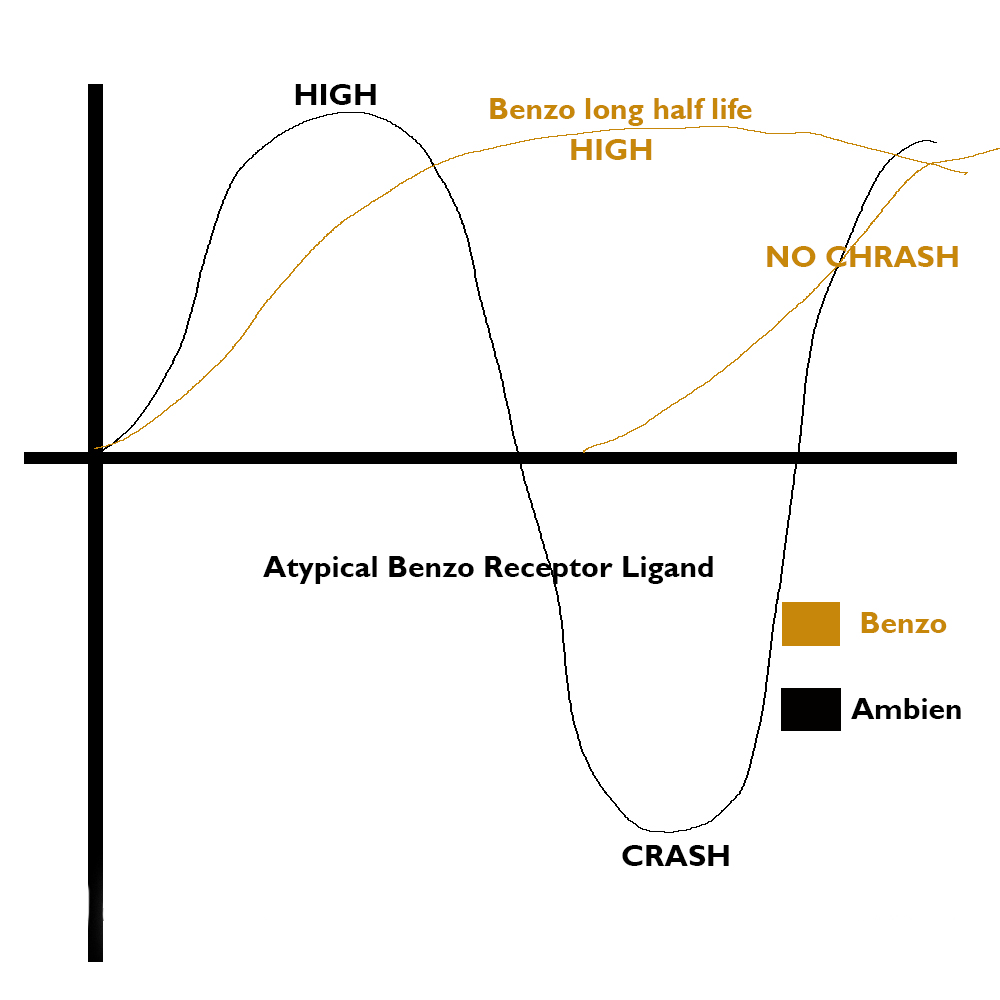
Half life is the time it takes for the drug to have 50% of its active ingredients leave your body. Thus for Ambien it is 2.6 hours per wikipedia where you can find all benzos in their categories and dose equivalences as well. It is not listed how fast it completely leaves the system but one can calculate it pretty quick. Half leaves in 2.6 hours; half of the second half also leaves in 2.6 hours and so forth. When you add it all up, basically the drug is nearly undetectable in 15 hours but it is still in the body to a minuscule level. The problem is that it completely left in less than 24 hours. Most doctors think that having a benzo or alike with short half-life out of your system (less 24) hours is a good thing. I drew you a little chart here so you can see how bad that is.
Time to high and low
As you can see on my little hand drawn scribble here real benzos–particularly ones like Valium (orange)–have very long half-lives–some longer than a day. That means that if one is on Valium, for example, one never experiences highs and lows because before one can crash by having Valium leave the system, a new dose is taken at night and the cycle begins without any noticeable drop in level.
At the same time, if you look at what happens in the case of a receptor ligand (black), you can see that it peaks in about 1 hour and by 2.6 hours half the drug left the system. If the dose is chosen right for sleep, by the morning–8 hours after taking it–one is supposed to be without any trace of the hypnotics.
But we have a problem. The receptors were modified and want more of the stuff they used since now they have a weird shape and need to get more Ambien to fill up the receptor. Only another ligand can fill that receptor now.
Believe it or not, in as short a time as 3 days a person can get addicted to Ambien and experience withdrawals! The withdrawal itself comes with severe anxiety, lack of ability to sleep, sweating and being cold at the same time, shiver or shake uncontrollably, ready to run a Marathon but feeling totally ill. This is after 3 days of taking this drug.
So, if you are a doctor, a psychiatrist, a hospital nurse practitioner, a PA, anyone with the power to prescribe atypical benzodiazepines receptor ligands, think twice and do not!
There are more natural ways to get to sleep. It is way better to offer a turkey–serotonin—that puts people to sleep after lunch; it will do so after dinner as well–change light bulbs to pinkish/orange–blue light keeps people awake–take Vitamin A–this is my accidental discovery that A resets circadian rhythm in rats and apparently in me too. Maybe it will work for you as well. Take a walk if you can. Do not watch TV or be on the computer like I am now. Do not read–unless you have pink light and the paper of the book or magazine is not shiny to wake you up. Drink milk–a very good sleeping pill alternative for those who like it–I love it and drink a glass every evening before bed.
If you still cannot sleep, seek out sleep therapies, relaxation techniques and perhaps other, long acting benzos. Yes, they are addictive but no, they will not make you stupid as the current belief is. Do not take any serotonin medications since they are more addictive than benzos only doctors deny that… but I ask them to take one.. and then we’ll talk in the morning 2 days later.
Keep your health in your own control. There are way too many MDs out there who think your life is theirs to play with! Actually it is their lives that is in your hands since without you they do not get paid! Treat them like you would anyone else you pay for service, like a grocery clerk! If you don’t like the apple they give you, you complain! Right? At your MD it is not about an apple but your life and health so yes, do complain!
Your suggestions are welcome, as always!
Angela
The last article on the migraine series is out. This one discusses the connection (if there is any) of hormones and migraines. Here is the start but head to read the whole article by clicking on read more after the introduction here.

Before puberty, migraines are three times more frequent in males than in females but after puberty the tides turn and females are more likely to suffer from migraines than males. An Oxford study found that females are twice as likely to have migraines and that
“brains are deferentially affected by migraine in females compared with males. Furthermore, the results also support the notion that sex differences involve both brain structure as well as functional circuits, in that emotional circuitry compared with sensory processing appears involved to a greater degree in female than male migraineurs.”
The overwhelming belief is that the connection is clear: the hormones kick in for women at puberty and that must be the reason. This begs the questions: 1) Do males have the same hormonal problems before puberty as females do after puberty? If hormones are at root of the problems, then there must be some similarities, right? 2) If female hormones are responsible for migraines, do all females have migraines when they reach puberty? 3) Do migraines cease when hormones stop changing after menopause? 4) What about pregnancy or postpartum, how do hormones impact women then? And finally, 5) Do men stop having migraines after puberty?
Some of the answers to these questions will surprise you and may make you wonder if hormones have anything to do with migraines at all. In this post, I show you that while there are some connections between hormones and migraine they might not be the primary drivers of migraine. The relationship between hormones and migraine is not in the presence of hormonal changes but what those changes require in terms of brain energy, the lack of which causes migraines… read more
I really did not want to write this article because I thought it was a boring topic but then I found out how many people receive SSRIs instead of Benzodiazepines (benzo from now on) because of two primary (and totally wrong) key reasons:
Well…. let me put my 2 cents into this argument because I feel like writing when I am angry. And boy am I angry! So let’s get two factors straight immediately. Anxiety is a break down of adrenaline release system caused by a perceived danger by the dopamine pathways of the brain. Anxiety is a fear of death. SSRIs on the other hand are created for depression. Depression is the wanting to commit suicide–thus the opposite of anxiety. It works the serotonergic pathways and not dopaminergic and so the two drugs have nothing in common. With this out-of-the-way, I can focus on addiction.
What is addiction? A new study, by Nielsen, a doctoral student working on his dissertation, ran an analysis at the Nordic Cochrane Centre. A meta analysis looking at data, which showed that the symptoms of coming off of the two types of drugs were nearly identical. But what is called “addiction” for benzos, is called “SSRI discontinuation syndrome.” A wonderful name; isn’t it? I know I am cheeky but it is intended. After all, what is a syndrome? A syndrome can even be fatal as in “serotonin syndrome” and so calling the withdrawal from SSRIs a “syndrome” makes it actually worse than addiction. But let’s continue to how addiction is defined by Dr. Lars Vedel Kessing, a clinical professor I am glad and proud to never ever have taken a class from!
His definition of addiction to benzos is as follows:
- First, you lose control and the desire to take the drug becomes compulsive. In some sense you could say the drug takes control of you, say Kessing.
- Next is the onset of tolerance.The dosage must be increased all the time to get the desired effect and you keep taking more and more of the drug.
- Directly related to this is the third symptom; a strong urge to privately obtain more of the drug so it can be taken without the physicians knowledge.
- Lastly, there will be a detrimental effect to the individual who will no longer be able to function socially of physically.
The interesting thing is that none of this is true. It may be true for an alcohol addict or an illegal street drug addict but certainly is not true for an ill person taking benzo for health!
I know first hand that it is all wrong since at age 19 I came down with severe anxiety–which later turned into part of the reason for my migraines, which you can read about in my book. I am now over 40 years later, still taking the same benzo and not only did I not increase my dose, I actually decreased it. I am a lot more personable now than I have ever been in my life. I have never ever had any strong urge to get more of my drugs; in fact my goal has been to get less and less over time. And lastly, there are no detrimental effects to me that stop me from functioning in the society. If anything it made me better at being able to function in the society.
Now could I just stop my benzo? Probably not. So is it addictive? Sure it is. Any drug that alters brain chemistry is addictive. So let’s visit SSRIs. I have written much before about SSRIs so if you want to find out how they commit their crime, visit some of my write-ups in this blog. Here is one that even has a drawing in it to help you understand how it works. I now know many people who take SSRIs. Luckily I am not one of them and never ever intend to be one.
I find that I am not able to find a single person for whom SSRIs actually work. But I do find that once they start it, they cannot come off of it. It may take years for them to come off of it and then they may have flashbacks for years! So here they were put on a drug that did not work–and I tell you in a moment why they did not work–and now the doctors have created a nightmare of people continuing to take a drug that doesn’t work simply because they cannot come off of it! So is SSRI addictive? You bet it is! Major it is! And it doesn’t work.
As I said I explain why it doesn’t work. Originally when SSRIs were first created, the application was for one purpose: Clinical depression. Not sure what happened to this term since it can no longer be found. I find people who receive SSRI for seasonal and situational (someone dies) depression which then is impossible to get off of and they are stuck for life or suffer withdrawals. It was not meant for their condition. Here is a short list of what SSRIs are now prescribed for (these are from Wikipedia):
Also prescribed for PTSD, chronic pain, and depersonalization disorder plus ADD, ADHD, and similar. The list of damages it causes I will ignore since it is too long but I do want to talk about 2 major problems. One is that it is supposed to be prescribed for clinical depression and that is not even listed. Secondly, those who take this medication often commit suicide. There is a bit of a confusion in there… it is counter intuitive to give a drug to a depressed who is suicidal that will end up helping them to commit suicide. So why are they promoted? What is the point? Do they even work? They don’t actually. Why not? A couple of possible reasons and one certain reason.
Possible reason popped up recently in the New York Times about the possibility of a pathogenic origin since many of the symptom of the depressed appear similar to some illnesses caused by pathogens and the depressed apparently have the marker of inflammation in the body! Thus there may be something physiological that is not in the brain! So why treat the brain?
Another trail of thought in the same paper is that it may have an evolutionary benefit in solving some big problems that requires withdrawal from normal behavior to complete. They call this rumination. They may sound far-fetched to you but way better than SSRI! Robin Williams’ death was a classic example of depression going out the window and there are other reasons. The for sure reasons are many but one of them is that a very few people diagnosed with depression actually get any benefit from SSRIs because their brains do not need extra serotonin. SSRIs force neurons to make serotonin 24/7 regardless if the person needs it or not. Too much serotonin can cause other troubles: serotonin syndrome (can be fatal), IBS and digestive troubles among other things.
Thus for those of whom SSRIs don’t work, they actually cause harm and addiction! It is clear that we know nothing about depression and it is also clear that SSRIs are handed out like candy for an illness we know nothing about. I just about had it with doctors wanting to replace my benzo that works just fine with SSRIs. I placed a permanent ban on my medical record on any form of serotonin and SSRI. I am the happiest person alive with an anxiety problem that is not “being anxious” or nervous. I have never ever had a depressed minute in my life. Have I been upset on some days? Sure. Depressed? Never.
I suggest the medical community review their practices in SSRIs and depression in general because the state of matter today is: they are wrong!
Comments are welcomed as always!
Angela
Richard Feinman, the Other
Pondering life and faith
A New Way of Being Migraine Free
Conversations with the Heartmind
A girl, PCOS, insulin resistance, and her journey to change her relationship with carbs
Explaining the link between itching, hot flashes, hormones, and menopause.
Be brave, little fighter. There's a warrior within you.
..................................The Case of HOUSTON versus HOUSTON.................................
The Physician Wellness Movement and Illegitimate Authority: The Need for Revolt and Reconstruction
The life of PASSION
A great WordPress.com site
Providing Help for Migraine Sufferers
Understand what makes us do what we do.
Each day is what you make it
Preventing and treating migraines without medicines
Enhance Your Knowledge
the Story within the Story


